open ended play

  • 4 Benefits of Play Dough

    Hi guys! It’s Chelsea, the Founder of The Dough Project, here to talk about the awesome things that come from playing with dough.

    But first, a little bit about me and my background in early childhood education!

    I started The Dough Project as a preschool teacher in NYC. Year after year, making dough was my go-to classroom hack. It was fun and easy to make. Even better, fun and easy to play with, build with, squeeze, smush and share again and again.

    After witnessing the magic that came from playing and creating in my classroom, I knew I needed to make it easier for families to recreate that experience at home.

    The Dough Project creates a world of kid-powered playing with jars of fresh playdough and DIY Mixes that come packed with everything you need to make your own dough at home. We use only all-natural ingredients and color from plant-based sources.

    So, what’s the deal with dough?

    Used on its own, with clay tools or loose parts, dough supports imagination, conversation and growth across developmental domains. When you watch children play with dough, without any agenda of your own, you’ll be amazed.

    At past dough parties, parents would be in awe watching their kids play. We’ve heard a lot of “wow, he’s so into it” and “I’ve never seen her sit this long” in our day.

    4 Benefits of Play Dough

    Speech and language

    Playing with dough facilitates conversation as children narrate their work, problem solve and tell stories. It’s a great way to introduce new vocabulary. Most importantly, it’s a wonderful opportunity for you to listen. Play quietly, they’ll talk to you.  

    Cognitive skills

    As children play and explore with dough, they begin to understand early quantitative concepts, like “a little” and “a lot.” They also begin to learn about geometric shapes, measurements, and balance.

    Fine motor skills

    All that squishing, mushing and rolling strengthens muscles and develops hand-eye coordination. These skills are critical for early writing and self-care, like getting dressed! 

    Self-regulation

    Similar to the relieving effects that come from squeezing a stress ball, playing with dough is great for little ones to calm themselves down, release energy and express emotions.  The sensory experience is grounding and can be very soothing. It’s the perfect way to unwind and reset. 

    And if you still need more convincing after all that, try out our all-natural, non-toxic dough made with just five ingredients!

    Use code PLT10 for 10% off your first order of dough. Then, watch the littles in awe as they play and create a whole new world with dough.

    About The Dough Project

    The Dough Project is on a mission to get both adults and little ones to think outside the jar. Using only all-natural ingredients (things you can find in your own pantry) and color from plant-based sources (like those beets you used in your salad), The Dough Project is obsessed with creating products that are high quality and safe, so kids can explore and play freely.

    The Dough Project believes playtime should be easy, enriching and well, fun. After witnessing the magic that came from playing and creating in her preschool classroom, Founder and CEO Chelsea Milkman wanted to make it easy for families to recreate that experience at home. The Dough Project creates a world of kid-powered playing with jars of fresh playdough and DIY Mixes that come packed with everything you need to make dough at home. So when you open a jar of dough or a box of the DIY Mix, you’ll instantly get inspired by the feeling of endless possibility.

    About Chelsea Milkman, Founder

    As an early childhood educator and Founder and CEO of The Dough Project, Chelsea Milkman is on a mission to make playtime easy, enriching and well, fun!

    Inspired by the values held at the core of her preschool classroom for 10+ years, Chelsea built The Dough Project on the foundational belief that kid-powered playtime is essential for learning and cultivating creativity—both in the classroom and more importantly, at home.

    Using all-natural and plant-based ingredients, The Dough Project encourages process based play through jars of fresh playdough and DIY Kits complete with all the ingredients you need to make dough at home.

    Want to create a more purposeful play space? I invite you to join us with our purposeful play space course.Get ready to transform your play space, gain back your own time, and help your kids play independently!
    Read More

  • Open-Ended Play: Its Value and Characteristics

    Open-Ended Play: Its Value and Characteristics

    Open-ended play

    “Go play!” Have you ever spoken these words to your child? Turns out you’re not being selfish – indeed, by urging your child toward open-ended play, you are looking out for his best interest. According to Jean Piaget, “Play is the work of childhood.” 

    Swiss scientist and developmental psychologist Jean Piaget, who died in 1980, educated the world as to the cognitive development of children. Piaget believed that children take an active role in the learning process, essentially performing experiments all day long.

    Like little scientists, they interact with the world, making observations as they go about their days.

    Children continually add to their knowledge of the world via these interactions, sometimes building upon existing knowledge or adapting previously held beliefs. Piaget held that, rather than being ‘little adults’, children have inherently different methods of thinking than adults.

    Furthermore, there are both qualitative and quantitative differences in the thought processes of younger versus older children.

    Based on Piaget’s theory of child development, and knowing that children learn EVERYTHING from their environment, what, exactly, should parents put in that environment? What should children play with?

    Toys Matter

    There’s certainly no shortage of toys available to purchase. Go to WalMart or Target, and you’ll be inundated with loud, colorful playthings at every price point.

    How about a doll? Or a drum set? What will your child learn from that – how will a doll impact your child’s development?

    Let’s talk about the best choices in toys.  This article isn’t a resource for buying specific toys, but rather it’s an explanation of open-ended toys, their purpose and value.

    We’ve all been the parent cleaning up after our preschooler’s birthday party. Gathering wrapping paper and packaging, plastic silverware and half-eaten, frosting-heaped cupcakes.

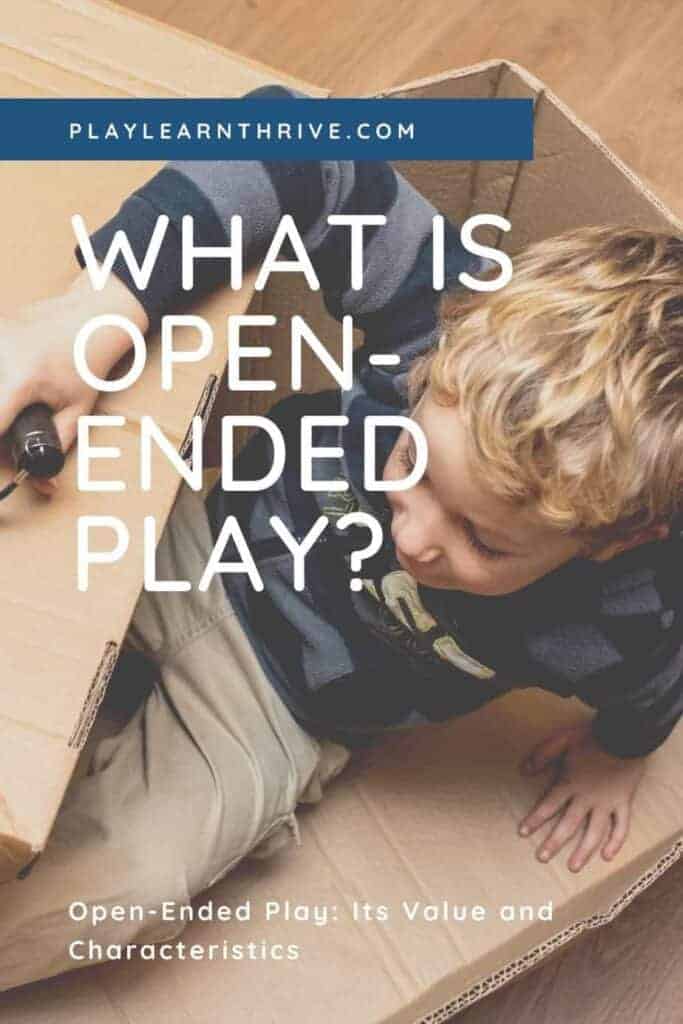
    Surveying the room, now filled with new playthings, we see our wondrous, already-gifted child, playing……..inside a box. THAT – that box – is an open-ended toy.

    Open-Ended Toys are Ideal

    How on earth, you wonder, could a cardboard box, whether open-ended or not, have more inherent play value than a scientifically-researched, state-of-the-art, $50 toy? WHY is my kid more attracted to that BOX than he is to this top-ten-parent-recommended plaything?

    Great question. The answer is perhaps less complicated than that cardboard box. One word: options.

    Open-ended toys have limitless options, while that $50 electronic keyboard has exactly one function – to play music. Valuable? Of course! What fun it is to play music! A keyboard will produce hours of melodic (read:noisy) fun…until it doesn’t.

    Either it breaks, the batteries wear out, or the child gets just plain tired of it. Or someone (not you – of course, not you) hides it.

    But the box? You will have to wrestle that box out of your kid’s hands.

    As in, literally have to throw it out when your child is out of the house.

    You may even resort to taking that box to your mother-in-law’s on trash day so that your kid doesn’t ‘rescue’ the box and bring it back into the house.

    So we’ve established that this box has lots of value as a plaything. What, exactly, is your child learning, developmentally, while playing with a box? What does open-ended play mean, anyway?

    Fine Motor Skills

    Ripping off the remaining wrapping paper and tape is great exercise for small fingers and hands. Perhaps your child will decorate the box using crayons or markers – maybe even paint. All of these activities strengthen those muscles that enable a child to hold a pencil, tie shoes, grasp a crayon, move a bubble wand, and zip a zipper.

    Gross Motor Skills

    Crawling, jumping and running through and around the box improve your child’s gross motor skills, as does balancing and mastering an obstacle course. Every time he climbs into or out of that box, he is getting stronger and more proficient at moving his body!

    Social-Emotional Development

    Your child might have siblings, and they might play with that box together. What a great opportunity to build social-emotional skills like working together, sharing, compromising, negotiating, empathy, sympathy, etc. It’s a BIG job to manage your own feelings! Inevitably, conflicts will arise – how will your child get through these conflicts? Will he talk, cry, whine, hit, or something else? Each time he navigates a disagreement, he learns tools for the future!

    Language/Literacy Skills

    Deeply connected to social-emotional skills, language skills are necessary for all of us to get through the day. We communicate verbally as well as non-verbally. Has this box suddenly turned into a bus? Through pretend play, your child will use language to test out new words relating to buses! Drive, horn, honk, exit, money, seat, etc. – what fun he will have trying out this new vocabulary! Language and literacy also refers to the written word, which might involve making tickets for the bus, or writing the name of the bus on the side of the box. Maybe your child will need a name tag because he’s the bus driver!

    Cognitive Skills

    Your child will be solving problems and making decisions in his own head before you hear one word of it! Where does his bus go? What’s that one song people sing about a bus!? Oh, yeah! ‘the wheels on the bus go round and round…’

    Does your child focus on creating his bus? Is he busy for thirty minutes solid before coming up for air? Or maybe he’s distracted by so many ideas at once. Open-ended play can be changed immediately by your child – with no adult help!

    Imagination

    This is where a box beats out a keyboard every time. On Tuesday, your child is ‘driving a bus’ with that box. By Thursday, the box has turned into a castle, and your child is the king. Your dog is a knight. Imagination has no limits.

    THAT is the value of a box – or, really, any open-ended toy. No amount of technology can do for the developing child’s brain what a box, a pile of clay, or a tub of wooden blocks can do.

    Tell your gift-giving friends, and remember this on your next visit to the toy aisle. You don’t need expensive toys – nor do you need a lot of toys. For engaging, self-directed learning to happen in your home, you need toys to encourage open-ended play.

    If you’re looking for more information about the importance of play and tips to reorganize your playroom check out my e-book: Simply Play: Everything You Need To Know About The Most Important Part of Childhood which you can buy here for only $4.99.
    If you like this post and want to read more like it then check out these articles:
    Outdoor Play: Why Does it Matter?
    Type of Play for Development
    100 Simple Things to do Outside With Your Kids
    Toy for Toddlers: Encouraging Active Play
    Top Toys to Encourage Outdoor Play
    7 Essential Playroom Spaces (and why you need them)
    The Power of Play
    What I’ve Learned about Early Childhood Education

    Read More