education

  • How to Rock Distance Learning During School Closures

    We’re all overwhelmed right now and can use some tips for distance learning. As teachers, we’ve been thrown a curveball. You are no longer a teacher within a building with resources and live people, you’re an online teacher. Some of your learners may not even have internet or digital access to “see” you. As parents, we’ve been told that our children are now essentially being homeschooled. Sure, there will be resources (through remote/distance/or e-learning) from teachers, but it’s not the same as having your student at school.

    I am feeling the pull in both directions right now, as a middle school teacher and a mom to a third-grader. As scary as this is, I know we can rock distance learning during school closures with these tips!

    Tips for Distance Learning

    Be flexible.

    Whether you are a parent or a teacher, this is your time to let things go. You don’t have to cover everything in a curriculum guide or every enrichment suggestion a teacher sends you.

    Parents

    • Take advantage of beautiful weather and take a walk (with appropriate social distance) around the neighborhood.
    • Let your child’s curiosity guide what they learn. Try having your child explore their own passion project at home!
    • Allow a later start and flexible scheduling if your child’s class is not meeting “live”. Some school start times are SO EARLY. This is a chance to have your child work when they learn best.

    Teachers

    • Don’t feel like you have to cover everything in your curriculum. It’s not feasible, and it’s not necessary. Focus on your end goals. What do you want your students to know and be able to do? How can you get there digitally?
    • Know that this is new for everyone. Chances are, you’ve never taught online. Your scholars haven’t been online learners.
    • If you are live teaching, give your students a bit of time at the beginning of class to share. Your learners may be struggling with social distancing right now. Some of their parents may have lost their jobs. Let them share what’s on their mind.

    Pay attention to social-emotional needs.

    At home, I am encouraging my daughter to talk about what she’s feeling every day. I do the same with my students. Pre-social distancing, I had a Google form where the kids could “check-in”. I adapted this from several other teachers online to make it my own for my students.

    This works just as well when the students are participating in distance learning.

    Here are some questions you’ll want to ask your students on the Google Form:

    How are you feeling today?

    I give multiple-choice options to answer this question. That way, in my spreadsheet, I can quickly scan the students that need a check-in or conversation.

    • 1. I am great.
    • 2. I am OK.
    • 3. I am “meh”.
    • 4. I am struggling.
    • 5. I am having a tough time and wouldn’t mind a check-in.
    • 6. I am not doing great.
    • For younger learners, you may want to use emoji options to have them express how they are feeling.

    How did you sleep last night?

    On a scale of 1-5 (little to no sleep to a perfect night of sleep), ask your students how they are sleeping. If you notice trends, you may want to have conversations with students, parents, or your counselor to make sure your students are getting enough rest to keep them healthy.

    How was your breakfast or lunch?

    I give a scale of 1-5 (skipped breakfast/lunch to the best breakfast/lunch ever). If you see that your students are frequently not getting to eat, you can reach out to your school counselor or administrator to help parents get resources if needed.

    Anything else I need to know?

    Give your students a chance to share things that are going on in their life. This is an overwhelming time for everyone. Leave this question optional since many students will be managing just fine!

    Other questions

    Daily check-in forms are also places to ask quick check for understanding questions or just for fun questions (What Netflix show are you watching? What do you miss the most about school? Who is your favorite Disney character?). You may ask your students to provide questions as well!

    Don’t make it all about the tech.

    I write a blog called Creative Tech Teacher, but I don’t think distance learning needs to be centered around technology. If your students have the tools to connect with you digitally, go for it! However, focus on learning, not the tools.

    For example, I am having my students write a historical account of their time away from school. They’ll do daily journaling using Google Slides with a template I share. However, if they want to write a paper journal or scrapbook, I will let them! It’s not about the tech; it’s about the learning.

    If your students do have access to the internet and devices, here are some awesome tools you may want to use for remote or distance learning!

    Embrace play!

    Don’t forget to give your students (and your own kids) time to play and explore during this time. Whether it’s playing outside (no play dates for now) or free play activities engaging their imaginations indoors, let your learners have time to play and share about their experiences!

    Ask for help.

    One of the few benefits of being away from my classroom is the way I’ve seen the community (and really the world) come together. Teachers are sharing their resources, parents are praising teachers and asking for help, and we’re all in this together! Some of my colleagues started a GlideApp (it is a website but looks like an app) where everyone is sharing and curating resources to help teachers during this time. Search for resources or add your ideas. Don’t be afraid to ask for help. I promise that if you send me an email (see my website in the bio), I will do my best to help you during this time!

    We’re all in this together. Whether you are a parent or a teacher, follow these tips to learn how to rock distance learning during school closures. Ask for help, be flexible, and try new things!

    Biography: Jen is a middle school public school teacher and PhD student in Omaha, Nebraska. She writes about education at Creative Tech Teacher.

    Read More

  • Free Self-Directed Learning Planner (Printable)

    What is self-directed learning?

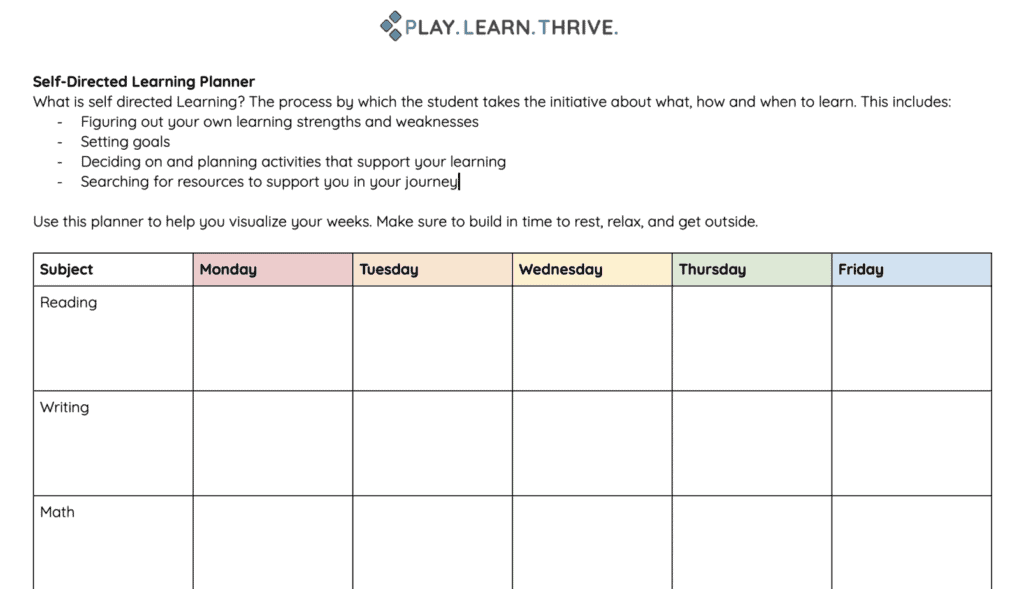
    Self-directed learning is the process by which the student takes the initiative about what, how and when to learn. This includes:

    • Figuring out your own learning strengths and weaknesses
    • Setting goals
    • Deciding on and planning activities that support your learning
    • Searching for resources to support you in your journey

    The whole idea of this approach is that it puts the child in charge of their own learning. It gives them a chance pursue interests, books, and hands on experiences that they might not have had access to previously or in a traditional school setting. For more information about this incredible approach to learning read this by Dr. Peter Gray.

    How to Get Started

    The first thing your child needs to do is determine their strengths and weaknesses. It’s also helpful for them to understand their learning style, and dig deeper into what types of content they actually enjoy learning.

    Once they figure out what they enjoy learning it will be easier for them to lean into that as a jumping off point.

    Use this self-directed learning planner to help you visualize your weeks. Make sure to build in time to rest, relax, and get outside.

    Click here for the printable self-directed learning planner.

    If you’re looking for more information about the importance of play and tips to reorganize your playroom check out my e-book: Simply Play: Everything You Need To Know About The Most Important Part of Childhood which you can buy here for only $4.99.

    If you like this post and want to read more like it then check out these articles:Understanding Schema Play

    The Power of Play

    The Ever Growing Importance of Outdoor Play.

    Toy for Toddlers: Encouraging Active Play

    100 Simple Things to do Outside with Your Kids

    What is Montessori–Understanding this Early Childhood Education Philosophy

    Reggio Emilia — A Child Centered Learning Approach

    What is Waldorf — A Spotlight on Waldorf Education

    Read More

  • Invitations to Play: A Misunderstood Concept

    Invitations to Play: A Misunderstood Concept

    An explanation of the phrase “invitation to play”

    Building off the concept of schemas is the idea of creating invitations to play. Simply put, an invitation to play is when an adult arranges toys in a way that is meant to spark a child’s interest.

    This is an amazing way to introduce new toys or get your child to expand their play by providing them with opportunities to make connections between toys they may not have seen for themselves.

    The common misunderstanding

    But there seems to be a fairly common misunderstanding about the purpose of invitations to play. This concept is directly derived from the Reggio Emilia philosophy of early childhood education.

    Reggio Emilia really focuses on following the child’s interest and using the environment as a third teacher. The materials provided in the child’s environment are meant to encourage exploration and spark interest without needing direction from adults.

    This concept has made its way from Reggio-inspired classrooms to the everyday parent who is looking to spark their child’s imagination. There are blogs, Instagrams, and Pinterest boards solely dedicated to giving moms ideas for invitations to play. And that’s great. However, I think it’s important to note a few things.

    I see moms constantly looking to get ideas for invitations to play. They seem stressed because they “can’t think of anything” or they are focused on providing their kids the perfect setup.

    I think that the concept behind creating invitations to play has gotten a little lost.

    How to Move Forward

    First, you don’t NEED to be doing this on a daily basis. In fact, you don’t need to be doing it at all for that matter. You child is perfectly capable of creating their own scenes for play if left alone with their imagination.

    That said, I understand wanting to.

    Maybe it brings you joy or you appreciate the way it allows your kids to play with things that might not always be top of mind for them. That’s amazing. You’re crushing it…

    I would encourage you to keep in mind that creating invitations to play is best done when you’re observing the schema (or schemas) that your child is really focused on in the moment and using that knowledge to create simple setups that build on their chosen focus. The idea is to follow the child.

    AND…Don’t stress if this is not your thing (it’s not really mine!).

    You can get TONS of ideas off Instagram and Pinterest, just PLEASE don’t beat yourself up over not being able to create picture-perfect invitations to play every day. I promise your little one will survive.

    If you’re looking for more information about the importance of play and tips to reorganize your playroom check out my e-book: Simply Play: Everything You Need To Know About The Most Important Part of Childhood which you can buy here for only $4.99.
    If you like this post and want to read more like it then check out these articles:Understanding Schema PlayThe Power of Play

    The Ever Growing Importance of Outdoor Play.

    Toy for Toddlers: Encouraging Active Play

    100 Simple Things to do Outside with Your Kids

    What is Montessori–Understanding this Early Childhood Education Philosophy

    Reggio Emilia — A Child Centered Learning Approach

    What is Waldorf — A Spotlight on Waldorf Education

    Read More

  • 100 Positive Things Parents are Experiencing Right Now

    Right now our world is filled with news about a virus spiraling out of control. Whole cities shutting down. Families being quarantined. Schools, businesses, restaurants and parks closing indefinitely. It’s a horribly stressful time for everyone.

    That said, it is in these times that it is the MOST important for us to look for the positives. There is always a silver lining.

    In just a few days, parents all over the country (and the world) have had their worlds turned upside down. Often having to work from home while also trying to continue their children’s learning.

    Read this list to see what parents have found to be unexpectedly amazing about having their family stuck at home.

    100 Positive Things Parents are Experiencing Right Now

    1. Discovering that your child has an incredible talent you never saw before.
    2. Being able to play with you kids during a lunch break.
    3. Drinking hot coffee with your significant other instead of in the car on the way to work.
    4. Being able to read your kids books before bed.
    5. Enjoying more meals together.
    6. Slow mornings that allow for a little reading, play or conversation before “going to work.”
    7. A longer shower.
    8. Comfortable clothes all day. Hello leggings!
    9. Learning new ways do elementary math.
    10. Introducing your kids to old movies.
    11. Reconnecting with nature, going on hikes, and bird watching.
    12. Teachers showing their ability to adapt.
    13. Parents showing their ability to lead their child’s education.
    14. Cancelling of standardized tests.
    15. Kids having time to engage in true play.
    16. More opportunities home cooking.
    17. Extra time with kids before they start formal schooling.
    18. Perfect time to potty train!
    19. Time for daily snuggles.
    20. Kids are able to sleep until their bodies are ready to wake up.
    21. Kids can slow down and enjoy breakfast and lunch.
    22. Watching your older children help support their younger siblings.
    23. Children making friends with kids around the country.
    24. Practicing language skills with children across the globe through online video chats.
    25. Grandparents tackling new technology to be able to see their grandkids.
    26. No alarms going off in the morning.
    27. Not having to pack lunches and snacks every morning.
    28. Being able to finally have a conversation with your teenager.
    29. Kids helping to cook and trying new foods while at home.
    30. Coming to the realization that your family is WAY over scheduled.
    31. Connecting with college aged friends and family to provide supplemental educational opportunities.
    32. Letting go of housework and reconnecting with family.
    33. Having extra time to learn new skills (riding a bike, knitting, gardening)
    34. Kids recognizing just how responsible and productive they are when they put their minds to something.
    35. Kids learning how to self-regulate their own schedules and take responsibility for their work.
    36. Having time to pursue passions outside of academic curriculum.
    37. Kids having ability to work on school work at their own pace without fear of judgement.
    38. Watching your kids take on projects just because they are interested in the topic.
    39. Being able to witness your child’s true ability shine through.
    40. Doing everything in pajamas.
    41. Wearing no real clothes so less laundry!
    42. Feeling like you finally understand your child’s needs, strengths and weaknesses and how these impact learning.
    43. Realizing homeschooling is not half as bad as you imagined it would be (in fact sort of liking it).
    44. Raising expectations for practical life skills and children rising to meet those expectations—hello laundry help!
    45. Breathing in more fresh air.
    46. School aged children starting to learn to play again.
    47. More awareness of amount of screen time.
    48. Being pleasantly surprised by what your child knows and can do.
    49. Learned to let go and let children do more for themselves.
    50. The ability to be a part of your child’s every day education and watching them grow.
    51. Breastfeeding moms not having to pump while at work!
    52. Learning that life needs to slow down and that we are rushing through moments that should be savored.
    53. Coming together to do all household work.
    54. Seeing first hand what classwork genuinely excites your child and what does not.
    55. Mid-day dance parties.
    56. Hearing your kids say they are actually enjoying learning.
    57. Being able to lean into the subjects and content you’re interested in and do them with your child.
    58. Sleeping in!
    59. Being aware of self-care while my children are watching.
    60. Siblings being able to spend more time together playing and learning.
    61. So much extra time to read and do things your enjoy.
    62. Actually laughing together.
    63. High fives from your kid when they figure something out.
    64. Whole families being able to take walks together.
    65. No fear of missing out.
    66. Being able to catch up on tasks and projects you’ve been putting off.
    67. Being able to discover new learning tools that you didn’t know existed—opening up a new world of learning for yourself and your child.
    68. Less arguments and no rushing to get dressed and out the door to catch the bus.
    69. Communities coming together to share resources, get creative and support each other in so many ways.
    70. Learning so much about your child’s real interests and passions.
    71. Being able to teach your child things you love to do.
    72. Realizing it’s okay to not know how to do something and figuring things out along the way (while your child watches)
    73. Learning to appreciate the flexibility in schedule of having kids home.
    74. Connecting on such a personal level with teachers and parents.
    75. Developing a new found respect for what teachers do every single day.
    76. Feeling a sense of pride for conquerer the learning curve of homeschooling.
    77. Learning to be more intentional with our time and resources.
    78. Becoming more aware of how your family can be more eco-conscious.
    79. Kids engaging in real authentic learning.
    80. Having more face to face and quality time with your family.
    81. Older siblings are being given the time and space to reconnect and enjoy each other’s company.
    82. Children of all ages learning practical life skills!
    83. Knowing what your kids are learning, not just hearing about it after the fact.
    84. Not worrying about whether or not your kids are eating enough at school.
    85. The ability to catch up with friends who you’re normally too busy to call.
    86. Realizing that you have been way too caught up in your career to appreciate all the good things.
    87. Committing to being grateful for all the good things in your life.
    88. Not having to wear make up.
    89. Getting in hours more of outdoor play every day (even as a family!)
    90. People generally being kinder and trying to help others in their community.
    91. Being able to have more one on one time with your kids.
    92. Kids being able to work in any position they feel comfortable in (standing, pacing, laying on the floor)
    93. Watching your children become more creative.
    94. Being able to witness your child’s firsts.
    95. Paying more attention to your health and wellness.
    96. Feeling a sense of togetherness and community since everyone is going through the same thing.
    97. The pride and joy parents are experiencing when they come up with a really great project to do with their kids.
    98. More people considering how their behaviors impact the lives of others.
    99. Appreciating the mess that your kids make because you have no where to go and aren’t as stressed.
    100. Developing a totally different outlook about how learning should look, sound, and feel.

    If you like this post and want to read more like it then check out these articles:

    How to Continue Your Child’s Education During School Closures

    Covid-19: Tips for When School Is Closed

    30 Ideas to Get Your Kids Playing Outside

    100 Outdoor Activities to Do with Your Kids

    Top 10 Must Have Art Supplies

    Type of Play for Development

    Risky Play for Kids

    Toy for Toddlers: Encouraging Active Play

    Read More

  • Play Based Learning During School Closures

    You’ve got everything organized and ready for Monday. Pencils, paper, glue, erasers, maybe a protractor for good measure — all the implements of a proper education. You’ve put a great deal of thought into how best to organize your “classroom” and you have some lesson plans up your sleeve now that school is out for the foreseeable future.

    I applaud your efforts to fill the gap in your child’s education now that the coronavirus has upended your family’s normal routine.

    And I’m going to stop you right there.

    Because all your plans, though well-intentioned, are completely unnecessary.

    There’s no need to panic. Child development experts want you to know: You can make the transition to homeschooling quite adeptly by allowing your kids to lead. The best part? The responsibility for “educating” your child doesn’t fall solely on you.

    In fact, with a little preparation, following your child’s lead and sharing control of educational choices puts learning where it belongs — quite literally, in your child’s hands.

    Play is a child’s best education

    If you’re like a lot of parents right now, you may find yourself jumping both feet first into something you haven’t thought about much since, well — since you yourself were in school. And like a lot of parents who find themselves suddenly responsible for their child’s “formal education,” you may tend to fall back on what you know — that is, “school” as you remember (or imagine) it: children at desks and the teacher standing at the front of the class, drilling them with info on a chalkboard and some kind of pointer and glasses that tightly pinch her scrunched-up nose.

    This is what’s been called the “grammar of schooling,” and like the grammar of language, these are the “rules” that define our understanding of “school” even if we never give them much thought. Classroom teachers, to be sure, give a lot of their time to the arrangement of desks and lesson plans and standardized tests.

    Fortunately for you, your classroom isn’t restricted by four walls and your lesson plans are free and all around you as long as you keep in mind one very simple rule: Children learn best through play.

    Play: how memories are made

    Think about it. Your child hears the trills of the spring’s first toads and asks, “Mommy, what’s that?” Maybe you don’t know! You could scour the internet or a library for an answer, or you could take an option not always available to teachers with 30 kids in a classroom: You can learn by direct investigation, or, in other words, through play — by allowing kids the freedom to make choices and manipulate materials and find out for themselves the answers to important questions.

    It’s called play-based learning, and seasoned educators and parents alike know that it’s how a child learns best. With that in mind, the National Association for the Education of Young Children (NAEYC) recommends these “five essentials to meaningful play” for those backyard investigations and field trips to the pond and other memory-making activities.

    Children make their own decisions.

    Allowing kids freedom to make their own choices (and mistakes!) is the heart of play-based learning. Parents and teachers can help by providing lots of open-ended materials for children to explore and get creative with. If you suddenly find yourself with a house full of kids on short notice, you can take comfort in the fact that the best and most widely available open-ended materials are also free and right outside your door. While a plastic toy rocket ship is often just a plastic toy rocket ship, the natural world provides infinite materials, from sticks to stones to pine cones, for children to discover and explore and use to make creative choices.

    Children are intrinsically motivated.

    Famed developmental psychologist Jean Piaget referred to play as the “work” that children do to make sense of their world. Kids have an internal guide — a natural impulse — to play as a form of discovery. Not sure how to satisfy restless children on short notice? Ask them what they’re curious about!

    Children become immersed in the moment.

    We remember the “good old days” of biking around our neighborhood and late evening baseball games in the backyard not because we’re simply victims of nostalgia but because we’re recalling the most formative memories from our childhood — memories solidified precisely because they were formed when, as children, we were immersed in our play and lost awareness of our surroundings and became focused completely on what we were doing. It is in that immersion that memories are formed — the kinds of memories that last a lifetime.

    Play is spontaneous, not scripted.

    Children are flexible in their play. Sometimes they’ll make a plan and stick to it; other times, their play will evolve as new information emerges. The “unknown” nature of play allows children to develop valuable life skills, both flexibility and persistence. Parents and teachers should certainly play cooperatively with children, but should resist the urge to make decisions for the child’s play. As children encounter challenges within their grasp, gentle guidance from a trusted adult (or “scaffolding”) can lead them to the next stage of their development.

    Play is enjoyable.

    What’s the difference between a visit to a swamp and completing a worksheet on frog habitats? The former is fun, the latter, less so. And that difference is all that matters to a child who is exploring her own world, because it’s this difference that determines whether a memory is relegated to the nether reaches of her brain and forgotten, or experienced as a novel — and therefore memorable — event.

    Whether you’re homeschooling by necessity or choice, or just interested in how you can keep children learning on weekends and summer breaks, now is the time for active, play-based learning, and that can come in many forms. Thank heaven you’re not restricted by state standards and testing requirements. When a child is making choices and doing something challenging, with the proper adult guidance and scaffolding, they’re learning. So make granola in the kitchen, learn to play dominoes, build a bridge, start that long-term project you don’t ever seem to have enough time for, and get outside for some all day recess!

    You don’t have to wait until Monday!

    Resources

    Nell, Marcia L., & Drew, Walter F. Five Essentials to Meaningful Play. https://www.naeyc.org/our-work/families/five-essentials-meaningful-play

    Tyack, D., & Cuban, L. (1995). Tinkering toward utopia: A century of public school reform. Cambridge, MA: Harvard University Press.

    If you like this post and want to read more like it then check out these articles:

    Covid-19: Tips for When School Is Closed

    30 Ideas to Get Your Kids Playing Outside

    100 Outdoor Activities to Do with Your Kids

    Top 10 Must Have Art Supplies

    Type of Play for Development

    Toy for Toddlers: Encouraging Active Play

    Read More