parenting

  • When Do Kids Start Sharing?

    When do kids start sharing? Think about that as you imagine this scenario. There you are, at a pool party with your new friends. This is great you think to yourself. Susie and Beth are my new best friends! I finally met some nice moms at the park!

    Then you hear it – a blood-curdling scream. Definitely your kid. You scramble to your feet to see what’s going on, only to see your just-turned-three-year-old wrenching his pool toy out of the hands of Beth’s son.

    Beth beats you to the scene of the crime, though, and when you arrive you can hear her imploring voice saying, “It’s okay, honey, he just wants to borrow it. Can you share?” Uh oh.

    You think to yourself when do kids start sharing?

    What’s Really Going on Here?

    It seems that parents start encouraging (or forcing) sharing before children can even crawl. What’s the reason behind this insistence?

    The cause of much of the parental angst accompanying the push to share is that we parents want to avoid being judged. We want to hear “What a well-mannered boy you have!”, not “Your child knocked my child down.”

    Parents want to raise likable children. We want conflict-free parenting interactions, regardless of where we are. We try to raise generous, selfless humans who genuinely care for others. Okay, great. But none of those adjectives apply to a two-or-three-year-old child. 

    What Is Sharing, Anyway?

    The word ‘sharing‘ does not mean to a young child what it means to an adult. To a very young child, ‘sharing’ is when he has to give his very favorite toy to another child. This may be for a few minutes, or it could mean forever – the child never knows.

    The idea that ‘sharing is caring’ simply doesn’t apply to toddlers. They don’t understand the concept, and are completely unable to put it into practice. ‘Sharing’ actually may as well be stealing from a toddler’s perspective.

    But MY Toddler Shares!

    No, he doesn’t. Yes, maybe he gives you a bite of his donut. Perhaps he brings you a block from time to time. This is not sharing. More likely, the child is seeking approval and looking for the positive feedback that comes when you enjoy a morsel of Krispy Kreme. Some children will even hold out a toy and then withdraw it, testing the waters during social interaction. It’s not sharing.

    When Do Kids Start Sharing?

    Around the age of two, most children recognize the concept of ownership and will protest if someone tries to take their toy away. But empathy? Fuggedaboudit. The two-year-old has no concept of others’ feelings – heck, he barely knows he is a separate person at this age. Still working on that.

    Another thing the two-year-old does not recognize? Time. So when you take his favorite lovey and give it to the enemy (read: another child), your toddler knows that rotten child will keep his prized possession FOR. EV. ER.

    Lastly? Impulse-control, for the win. The toddler’s creed tells all you need to know: “If I want it, it’s mine. If I give it to you and change my mind later, it’s mine. If I can take it away from you, it’s mine. If I had it a little while ago, it’s mine.” At the first inkling of ownership, the toddler snaps, screams, demands, hits, kicks……you know the drill.

    Moving Along the Continuum of Sharing

    Like all stages of child development, you can expect to go two steps forward and one step back as your child begins to share. It’s not like Tuesday your child won’t share, but then on Wednesday he magically will. When do kids start sharing? There is no precise age, but here are some tips for moving your child towards the act of sharing.

    Give a Play-By-Play

    Tap into your inner sportscaster as you narrate what’s happening between playmates. Using a calm tone, describe the actions of the children relative to the desired object (“You want the truck, but Timmy has it now.”) encouraging and praising the waiting child. By giving language to the situation, you may help both children to process the incident.

    Bring a Timer

    Even though the result is no better, ‘taking turns’ sounds better to a toddler than ‘sharing’. Armed with your timer, you can adequately supervise these turns, ensuring both parties get a fair shake. Your child will begin to learn that when someone else has a turn, it isn’t forever. As a bonus, the timer is the ‘bad guy’, not the parent!

    Ensure Safety

    If and when your child’s frustrations turn to hitting, kicking, or other violent actions, take a consistent stand. Make it clear that you will not allow him to hurt other people. If this requires you to hold him still, do so. Despite your upset, speaking and acting calmly will encourage your child to remain calm, as well.

    Edit Toys For a Playdate

    If you know that more than one child will be dying to play with a particular toy, put it out of sight for the playdate. If your child just isn’t ‘there’ yet about sharing, why ask for trouble? Be sure to make clear to your child that the toy in question is off-limits during the playdate.

    Model

    Children are constantly watching and listening. When having a bowl of ice cream, ask your husband if he’d like to ‘share’. Make a point of ‘sharing’ the couch with your child and reading a book or watching a show together. Make this language prevalent in your home.

    Also make a point of using the phrase ‘take turns’, and demonstrate this for your child. “Dad and I are taking turns watering the garden.” The more he hears these phrases and sees peaceful actions alongside them, the more normal sharing and taking turns will seem.

    Wait

    Our kids develop on their own timeline. Be patient, and know that stomping your feet and insisting your child share will likely have the opposite of your intended effect. Your child will learn to share. Eventually. While you’re waiting, take a deep breath and enjoy him for who he is right now.

     

    Want to create a more purposeful play space? I invite you to join us with our purposeful play space course.Get ready to transform your play space, gain back your own time, and help your kids play independently!

    If you want more individualized help you can set up a free 15 minute consultation to chat about your play space design needs.

    Want more information about the importance of play and tips to reorganize your playroom check out my e-book: Simply Play: Everything You Need To Know About The Most Important Part of Childhood which you can buy here for only $4.99.
    Do you like this post? If so, check out some of these related articles.
    Make Organizing Your Play Space a Priority
    Outdoor Play: Why Does it Matter?
    Type of Play for Development
    Toy for Toddlers: Encouraging Active Play
    Top Toys to Encourage Outdoor Play
    The Power of Play   


    Read More

  • A Parent’s Guide to Growth Mindset

    The concept of mindset, coined by Dr Carol Dweck, Stanford psychologist, is the idea that parents need to understand. Dweck notes that there are two different types of mindsets. 

    A fixed mindset and a growth mindset.

    Fixed Mindset

    A fixed mindset is when a person believes that their skills, abilities and knowledge are unchangeable. They often feel they are either “good at” something or “not good” at something–with no room for improvement. People with a fixed mindset don’t believe they have the ability to change their intelligence. The phrase “I’m just not good at math” is something teachers hear often–this is an example of a fixed mindset.

    Growth Mindset

    On the other hand, a growth mindset is when a person believes that they can change their intelligence, skills and abilities through hard work. People with a growth mindset will often attribute their achievements to effort not an innate quality. 

    Want to raise a kid who loves to learn? Check out these books.

    Why it’s Important for Learning

    A child’s mindset has a huge impact on their ability to be successful–not only in academics but also throughout life. 

    A growth mindset will allow children to feel confident in themselves and be less fazed by mistakes and failures. 

    Here are 5 things parents can do to encourage a growth mindset.

    1. Allow for Productive Struggle

    Create simple opportunities where children have to engage in productive struggle. This will mean you have to build in time for reasoning, puzzling and thinking. Let children attempt to do something on their own even if you think it’s too hard for them. When you see them struggle, give encouragement vs “taking away the struggle” by doing it for them. We want to teach them that the struggle to understand is part of the learning process. Teach them that the initial “I don’t know how” can be replaced with “How can I figure this out”

    1. Encourage Persistence 

    Not everything your child does is going to come easy. Make sure you acknowledge that and praise their effort. Remind them that it’s okay to be frustrated. It’s even okay to take a break and work on something else. Have them think about the process they are using to solve the problem, ask them questions and help steer them in the right direction without letting them give up.

    1. “I can’t do this” is not allowed. 

    This phrase holds children back from learning new concepts and material. It might be because they truly don’t understand, or because they are tired or frustrated. But using that phrase should be a no go in your house. Ask them why they think they can’t. Have them talk through the process and answer your questions vs you just explaining your personal reasoning.

    1. Talk About the Brain as a Muscle

    When children understand that their brain can actually grow, stretch and get “stronger” they are more likely to take on challenges that allow for that growth. Explain to them that the brain needs to work out, just like any other muscle, in order to grow.

    1. A Positive Brain is a Smarter Brain

    Children who have a positive outlook are more motivated and productive–they also are much more likely to achieve their goals. Brain chemistry can be altered by movement–so make sure your children engage in physical activity throughout the day. We can also create a positive outlook by encouraging our children to be conscious of their thoughts and feelings towards learning. This will allow them to shift negative thoughts if necessary.

    Growth Mindset and Math

    There is a widespread belief that some people are just not math people. This is absolutely not the case. In fact, that reasoning is a perfect example of a fixed mindset. 

    We know that more kids have a fixed mindset about math, more than any other subject. It’s important we remove the pressure of math, make sure children understand that the brain actually grows when mistakes are made.

    You can read more about specific ways to counter fixed math mindset here.

    A Counterintuitive but Critical Part of the Learning Process

    Here are three crucial ways parents can help children in the learning process.

    1. Embrace mistakes. 

    Mistakes are how we learn. Talk about learning from your own mistakes and encourage your child to talk about what they have learned from their past mistakes.

    1. Encourage healthy risk taking. 

    If children aren’t encouraged to take healthy risks when they are younger, they won’t learn how to properly assess and handle risks later in life–when the stakes are higher.

    1. Celebrate failure.

    Failure is only feedback. No one who has ever done great things, has done so without failure. Shifting our mindset to appreciate failure as a part of the process is a game changer for many children. Failure is just a problem to be solved. 

    Understanding Praise

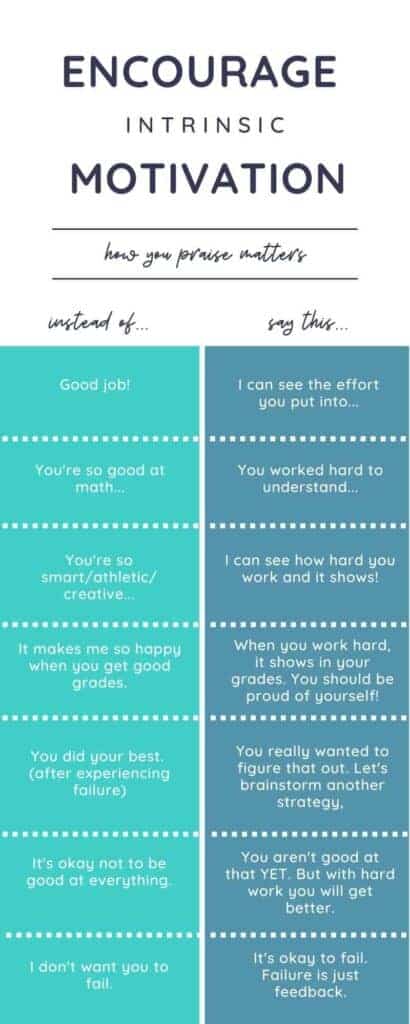
    Naturally parents want to praise their children. But it’s important to understand that the way you praise your child, has a significant impact on their growth and development. Specifically as it relates to their ability to develop a growth mindset and intrinsic motivation.

    The most important thing to understand is that we should focus on praising effort vs. outcome. Here is a list of specific phrases to incorporate into the feedback and praise you give to your child.

    Watch Carol Dweck speak about the concept of growth mindset: Developing a Growth Mindset

    Get ready to transform your play space, gain back your own time, and help your kids play independently! I invite you to join us with our purposeful play space course.

    Want more information about the importance of play and tips to reorganize your playroom check out my e-book: Simply Play: Everything You Need To Know About The Most Important Part of Childhood which you can buy here for only $4.99.
    If you like this post and want to read more like it then check out these articles:
    Make Organizing Your Play Space a Priority
    Outdoor Play: Why Does it Matter?
    Types of Play for Development
    Toy for Toddlers: Encouraging Active Play
    Top Toys to Encourage Outdoor Play
    The Power of Play

    Read More

  • A Guide to Keeping Kids Busy

    How to Keep Kids Busy

    Do your kids constantly complain about being bored? Do they always need you to play with them?

    With everything kids have access to nowadays, how could they possibly be bored? How could a child with every hot new toy under the sun have trouble playing?

    Parents seem to be dealing with this more and more frequently. And report it starting earlier and earlier in childhood.

    Just a few days ago a mom was posting that her 18 month old was bored and she didn’t know what to do to keep him busy.

    Earlier today I came across another mom of a 6 month old asking for ideas to keep him entertained–expressing that she had “done” everything she could think to do for him.

    And that right there, friends, is the problem.

    So let’s talk about this whole idea of keeping kids busy. In theory this is well intentioned, but in practice it is deeply flawed.

    Children don’t need to be, nor should they be, hovered over or have every minute of the day perfectly choreographed.

    Giving the Gift of Boredom

    Unfortunately, hyper focus on our children has left our kids incapable of dealing with any lull in stimulation and hindered their ability to play independently.

    We forget that it is not our job as parents to “keep our kids busy” or “keep them entertained.” In fact, doing so directly impacts their ability to do these things for themselves.

    Our job is to provide a safe space with access to open-ended toys, art supplies and books and leave them alone. They will entertain themselves.

    The problem is that many children haven’t been given the gift of boredom.

    Boredom is what gives children the time to figure out what makes them happy, and allows them to develop skills like creativity, imagination, self-reflection, patience, and independence.

    Shifting Our Mindset: Do Less to Do More

    So for all the parents wondering how to keep their children busy during this time, I encourage a shift of mindset.

    Do less to do more.

    Children of all ages are capable of much more than we believe them to be.

    Don’t think about how to “keep them busy” instead find ways to encourage them to be independent by providing open ended toys that allow for more active play.

    Tips to Encourage Kids to Independent Play

    Minimize the amount of stuff you have out for your kids. If you are overwhelmed by the amount of toys out, imagine how they feel. 

    As a general rule, stay away from standard plastic and toys that light up, make noise, or talk. These types of toys can actually hinder play for children because they take away the need for imagination and creativity.

    Remember that the more a toy does, the less your kid has to do.

    Play is the work of the child so keep in mind the 90/10 rule when evaluating toys. That means a toy should do no more than 10 percent of the work.

    You want your child doing the thinking, visualizing, and creating.

    If you want some specific toy recommendations you can check out this post.

    Educational Toys Don’t Encourage Learning

    Many of the most common toys today actually take these opportunities away from kids. And while they are often labeled as educational, they don’t actually teach your child anything but how to be entertained by something else–leaving them wanting more and more.

    How many times has your child loved a bright shiny new toy, only to be over it after a few days or weeks. This is because the toy has done all it can for them, and they are looking for their next fix of stimulation.

    If they aren’t given enough time to rely on themselves for stimulation, you end up with kids who constantly need someone (you) or something (a new toy, activity, device) to keep them busy. It’s a pretty vicious cycle with pretty deep consequences.

    The Solution to “Keep Kids Busy”

    So the solution is pretty simple. Stop spending all your time trying to keep them busy and they will stop needing you to keep them busy. Trust in their ability to deal with their own discomfort (and don’t let their discomfort be yours).

    One of the best things you can do for your child is to let them figure things out for themselves.

    If you’re looking for more information about the importance of play and tips or reorganize your play space check out my e-book:Simply Play: Everything You Need To Know About The Most Important Part of Childhood which you can buy here for only $4.99.
    If you like this post and want to read more like it then check out these articles:7 Essential Playroom Spaces and Why You Need ThemHow to Continue Your Child’s Education During School Closures

    5 Tips for When School is Closed

    Understanding Schema Play

    The Power of Play

    The Ever Growing Importance of Outdoor Play.

    Toy for Toddlers: Encouraging Active Play

    100 Simple Things to do Outside with Your Kids

    Read More

  • Free Learning from Home Schedule (Printable)

    Learning at Home Schedule

    Looking for a learning from home schedule? Having a daily schedule for your family is important as it sets up a predictable routine for your kids. Kids thrive on structure but that doesn’t mean that you need to have an hour by hour schedule with explicit activities booked for every minute of the day. In fact, it’s often less stressful for everyone to allows for some flexibility. Having a daily rhythm allows you to set the tone for the day, but not feel trapped or frustrated when something doesn’t go exactly as planned.

    Block Schedule to Create a Daily Rhythm

    A block schedule allows you to think about your day in manageable chunks of time–approximately 2-3 hours at a time. Long enough for you to accomplish tasks or for your kids to really engage in something, but short enough to provide enough changes that they don’t feel stuck.

    Above is the sample block schedule that works pretty well for my family. We do shift things around when needed, and every day isn’t the same but I find having a simple block schedule allows us to create a daily rhythm for our family.

    Click here for the printable block schedule to help you create a daily rhythm for your family.
    If you’re looking for more information about the importance of play and tips or reorganize your playroom check out my e-book:
    Simply Play: Everything You Need To Know About The Most Important Part of Childhood which you can buy here for only $4.99.
    If you like this post and want to read more like it then check out these articles:How to Rock Distance Learning During School ClosuresHow to Continue Your Child’s Education During School Closures

    5 Tips for When School is Closed

    Free Self-Directed Learning Calendar (Printable)

    100 Positive Things Parents Are Experiencing Right Now

    Understanding Schema Play

    The Power of Play

    The Ever Growing Importance of Outdoor Play.

    Toy for Toddlers: Encouraging Active Play

    100 Simple Things to do Outside with Your Kids

    Read More

  • How to Rock Distance Learning During School Closures

    We’re all overwhelmed right now and can use some tips for distance learning. As teachers, we’ve been thrown a curveball. You are no longer a teacher within a building with resources and live people, you’re an online teacher. Some of your learners may not even have internet or digital access to “see” you. As parents, we’ve been told that our children are now essentially being homeschooled. Sure, there will be resources (through remote/distance/or e-learning) from teachers, but it’s not the same as having your student at school.

    I am feeling the pull in both directions right now, as a middle school teacher and a mom to a third-grader. As scary as this is, I know we can rock distance learning during school closures with these tips!

    Tips for Distance Learning

    Be flexible.

    Whether you are a parent or a teacher, this is your time to let things go. You don’t have to cover everything in a curriculum guide or every enrichment suggestion a teacher sends you.

    Parents

    • Take advantage of beautiful weather and take a walk (with appropriate social distance) around the neighborhood.
    • Let your child’s curiosity guide what they learn. Try having your child explore their own passion project at home!
    • Allow a later start and flexible scheduling if your child’s class is not meeting “live”. Some school start times are SO EARLY. This is a chance to have your child work when they learn best.

    Teachers

    • Don’t feel like you have to cover everything in your curriculum. It’s not feasible, and it’s not necessary. Focus on your end goals. What do you want your students to know and be able to do? How can you get there digitally?
    • Know that this is new for everyone. Chances are, you’ve never taught online. Your scholars haven’t been online learners.
    • If you are live teaching, give your students a bit of time at the beginning of class to share. Your learners may be struggling with social distancing right now. Some of their parents may have lost their jobs. Let them share what’s on their mind.

    Pay attention to social-emotional needs.

    At home, I am encouraging my daughter to talk about what she’s feeling every day. I do the same with my students. Pre-social distancing, I had a Google form where the kids could “check-in”. I adapted this from several other teachers online to make it my own for my students.

    This works just as well when the students are participating in distance learning.

    Here are some questions you’ll want to ask your students on the Google Form:

    How are you feeling today?

    I give multiple-choice options to answer this question. That way, in my spreadsheet, I can quickly scan the students that need a check-in or conversation.

    • 1. I am great.
    • 2. I am OK.
    • 3. I am “meh”.
    • 4. I am struggling.
    • 5. I am having a tough time and wouldn’t mind a check-in.
    • 6. I am not doing great.
    • For younger learners, you may want to use emoji options to have them express how they are feeling.

    How did you sleep last night?

    On a scale of 1-5 (little to no sleep to a perfect night of sleep), ask your students how they are sleeping. If you notice trends, you may want to have conversations with students, parents, or your counselor to make sure your students are getting enough rest to keep them healthy.

    How was your breakfast or lunch?

    I give a scale of 1-5 (skipped breakfast/lunch to the best breakfast/lunch ever). If you see that your students are frequently not getting to eat, you can reach out to your school counselor or administrator to help parents get resources if needed.

    Anything else I need to know?

    Give your students a chance to share things that are going on in their life. This is an overwhelming time for everyone. Leave this question optional since many students will be managing just fine!

    Other questions

    Daily check-in forms are also places to ask quick check for understanding questions or just for fun questions (What Netflix show are you watching? What do you miss the most about school? Who is your favorite Disney character?). You may ask your students to provide questions as well!

    Don’t make it all about the tech.

    I write a blog called Creative Tech Teacher, but I don’t think distance learning needs to be centered around technology. If your students have the tools to connect with you digitally, go for it! However, focus on learning, not the tools.

    For example, I am having my students write a historical account of their time away from school. They’ll do daily journaling using Google Slides with a template I share. However, if they want to write a paper journal or scrapbook, I will let them! It’s not about the tech; it’s about the learning.

    If your students do have access to the internet and devices, here are some awesome tools you may want to use for remote or distance learning!

    Embrace play!

    Don’t forget to give your students (and your own kids) time to play and explore during this time. Whether it’s playing outside (no play dates for now) or free play activities engaging their imaginations indoors, let your learners have time to play and share about their experiences!

    Ask for help.

    One of the few benefits of being away from my classroom is the way I’ve seen the community (and really the world) come together. Teachers are sharing their resources, parents are praising teachers and asking for help, and we’re all in this together! Some of my colleagues started a GlideApp (it is a website but looks like an app) where everyone is sharing and curating resources to help teachers during this time. Search for resources or add your ideas. Don’t be afraid to ask for help. I promise that if you send me an email (see my website in the bio), I will do my best to help you during this time!

    We’re all in this together. Whether you are a parent or a teacher, follow these tips to learn how to rock distance learning during school closures. Ask for help, be flexible, and try new things!

    Biography: Jen is a middle school public school teacher and PhD student in Omaha, Nebraska. She writes about education at Creative Tech Teacher.

    Read More