parenting

  • Terrible twos, threenager, and f* you fours

    Terrible Twos, Threenager and….

    We have all heard the phrases “terrible twos,” “threenager,” and my favorite “the f* you fours.”

    I always tell my friends with younger kids (or friends thinking about having kids) that you get a baby first because you need to have some time to develop that love before they turn into beasts.

    I’m not going to lie, the toddler and pre-school years are rough. 

    I have found myself on the verge of tears many evenings just watching the clock slowly tick tock it’s way closer to bedtime (but then started to panic a little inside because I knew bedtime was going to be a — show).

    Toddler Behavior

    So while I’ve been there (and I’m sure will be there again). My advice is this; We need to reframe our perception of these years.

    Hear me out.

    You know that idea the power of positive thinking? Well it works the opposite way, too. If you think things are going to suck, they probably will.

    And here’s the thing. THEY WILL SUCK but they will suck a little less if you have the right attitude.

    Part of the reason it feels like it’s so hard is because our expectations are, in a way, too high.

    I often bang my head against the nearest wall after asking my 2.5 year old to listen to a direction, but then I remember she has been on this earth for 2.5 years.

    She isn’t SUPPOSED to listen at this age. She is SUPPOSED to be testing me. 

    Testing boundaries.

    That doesn’t mean I let her get away with not listening, it just means I accept that she is still working on it, try to find the humor in her shenanigans and calmly “help” her do whatever it is I’m asking her to do. ,

    Setting Boundaries

    Setting boundaries for your kids is probably one of the absolute most important things you can do as a parent.

    Not only does setting a healthy boundary help children feel more safe and secure, having solid boundaries allow you to have a more enjoyable parenting experience #winning

    So many struggles with this age group happen because parents are not confident in the boundary they set. They feel responsible for making their child upset or they don’t even set the boundary because they don’t want to have to deal with the inevitably unhappy reaction from their little one.

    I get it, it sucks sitting through those big emotions. 

    It can be embarrassing and overwhelming AF, especially if we are out of the house or have friends or family over. But if we just accept that little kids have big emotions, confidently set clear and firm boundaries and remind ourselves that it isn’t our jobs to make our kids happy everyone will be happier in the long run.

    Understanding the “why” behind kids testing boundaries

    Bottom line. This is what they are “built” to do. They are literally searching for that boundary.

    “What happens if I do this?”
    “What happens if I do that?”

    Where does that line exist and what happens if I cross it. Is my parent going to consistently enforce that boundary?

    Kids thrive on predictably. If you are wishy washy on where that line is, they will continue to look for that line. This will look and feel to you like they are “acting out” or “testing you.”

    Think about it like a box. They want to have very clearly defined walls. Those walls keep them from feeling overwhelmed and unsure.

    We need to keep in mind that it is completely developmentally normal for them to be testing us. It won’t make them stop, but that adjustment in mindset will help us get through it with a lot more grace.

    Strategies for dealing with negative behavior

    Young kids are going to behave poorly at some point or another. That’s just the nature of the beast. But there are definitely some ways we can respond that will help them (and us!) through.

    • Get down on their level. Standing over little kids is intimidating AF. You are big. They are small. They are going to automatically feel things more and act out more if they feel a need to compensate, or like they are being challenged (which they might more easily feel if they have a big adult standing over them).
    • Help them identify their feelings. Acknowledge that they feel sad, tired, angry, frustrated, mad, insert whatever crazy emotion is coming out. Tell them it’s ok to feel whatever they are feeling.
    • Let them feel those big feelings. So many times I see advice to distract kids from what they are feeling. I’m wholeheartedly against that. On a fundamental level we want kids to PAY ATTENTION to their feelings not be distracted from them. How can they learn to manage their emotions if they are constantly being “distracted” from what they are feeling?
    • If they need to release something like anger let them. If they are trying to hit you say something like “I can’t let you hit me but you can hit this pillow”–we are not encouraging violence, we are encouraging healthy ways of letting our frustration. The more control they get over their emotions, the less they will need to physically release those emotions.
    • Stop letting their feelings be your feelings. Don’t let them get under your skin. The more they see you being pulled into their emotions, the more they will feel those emotions. You have to be confident in your role as parent–every little emotion your child feels does not have to invade your own emotions.
    • Get quiet. This works for my high school students, and it works for my kids. If you yell, kids tune out. If you whisper they want to quiet down to hear what you’re saying. It’s a natural reaction that can help be better listeners. The louder they get, the quieter you should get.
    • Stay in control. The more out of control your child is, the more in control you have to be. This goes back to not letting them suck you into their nonsense.
    • Teach them skills to calm their body. We teach breathing–and ask the kids to take a couple deep breaths. My two older ones have VERY big feelings. They have learned to calm their bodies (and can do this fairly consistently), and they have also learned to ask for help calming down. They will be  hyperventilating and yelling “help me calm down!!” It’s both stressful and adorable at the same time.
    • Use a TIME IN not time out. Putting kids in time out doesn’t work. Even if it works in the short term, it doesn’t in the long term. Time outs teach kids that they are alone in their feelings, they bring on feelings of shame (not good for little ones who are just beginning to develop their sense of self), and invite power struggles. The better approach is a “time in”–you can still bring them to a safe space but you should help teach them to calm themselves, remind them that you love them, and then come up with some strategies or compromises that work for dealing with the underlying issue.

    The difference between a “meltdown” and a “tantrum”

    This was an eye opening concept for me as a parent. These two experiences can look the same but they are very different.

    Meltdowns

    A meltdown is typically going to happen when kids are overtired, hungry, thirsty, sick, overstimulated. 

    Maybe a toy isn’t working the way they want it to, or someone took a toy they wanted to play with, or they are experiencing too many feelings at once.

    Often it is helpful to remove the child from the situation and find a calm, quiet place. Help them calm down, suggest to them that they might be hungry, thirsty or tired so they can begin to recognize those feelings.

    I use phrases like “see, you didn’t eat your snack, and you are hungry. When you are hungry it is hard to be control your body.”

    Helping them make that connection between a physical need and their emotional state is going to help them in the long run (even though it may not help them in the immediate situation).

    Tantrums

    A tantrum is a response to not getting one’s way. 

    You tell them they can’t have another cookie and they throw themselves on the floor. They don’t want to leave the playground so they start screaming, kicking, sobbing like the world is going to end.

    The best way to deal with a tantrum to be consistent and not give in to whatever it is that is causing that tantrum. If you give in and give them that extra cookie, they realize “oh hey, I can act this way and get what I want.”

    Acknowledge their feelings, tell them you understand that they want whatever it is and then just let them have their feelings (and it might be ALL THE FEELS). 

    When they are calm enough, help them understand what they need to do to get whatever it is they want. You want that extra cookie, but we are all done with cookies today. We can talk about you having another cookie tomorrow!

    And move on. Don’t dwell. Don’t engage in discussion.

    My kids favorite strategy is to tell me they have a plan! I calmly listen to their plan, thank them for it, and reiterate what I have already decided.

    Often they agree to go along with it fairly easily and they say something like “oh ok! maybe we can do my plan tomorrow” and I’m all like yeahhhhhh maybe….. But for real. I do try to take their ideas into consideration and come up with compromises about things that aren’t safety or health related. It does help them feel like they have some control and it strengthens your bond.

    For further reading

    See below for some of my favorite discipline resources:

    No Bad Kids: Toddler Discipline Without Shame  by Janet Lansbury

    No Drama Discipline- The Whole Brain Way to Calm the Chaos and Nuture Your Child’s Developing Mind by Daniel J. Siegel

    How to Talk so Little Kids Will Listen: A Survival Guide to Life with Children Ages 2-7 by Joanna Faber and Julie King

    Siblings Without Rivalry by Adele Faber and Elaine Mazlish
    Read More

  • Sibling rivalry: How to stop all the fighting

    Healthy sibling relationships

    People always ask if I’m crazy when I say I want more kids. I guess the short answer is, yes, yes I am. But seriously, I think one of the best gifts I can give my kids is their siblings. That’s not to say it is a cake walk–one of the hardest parts of having more than one kid is managing the relationship they have with each other. Some days it seems like they wake up with the goal of destroying one another. After a few rough weeks and after hearing a bunch of mamas talk about having some of the same issues, I decided to re-read one of my favorite parenting books called Siblings Without Rivalry (you can buy it here) but I will break down some of the most important take aways.

    Don’t Compare

    It’s so hard not to compare your kids to each other. But doing so pits them against one another. Instead just DESCRIBE what you see, what you like or don’t like, or what needs to be done. Keep it based on your observation of that particular child.

     Things can’t and shouldn’t be “equal”

    Instead of worrying about trying to make things equal, it’s more important to focus on what each kid NEEDS (nothing is EVER going to be equal, but that doesn’t mean it can’t be fair). The last thing you want is kids feeling like one is the “favorite” and to avoid this you need to provide for each kid uniquely.

    Avoid placing kids in roles

    It’s important not to label kids with qualities whether good or bad. Pointing at one for being social and the other for being shy only brings a bigger divide.

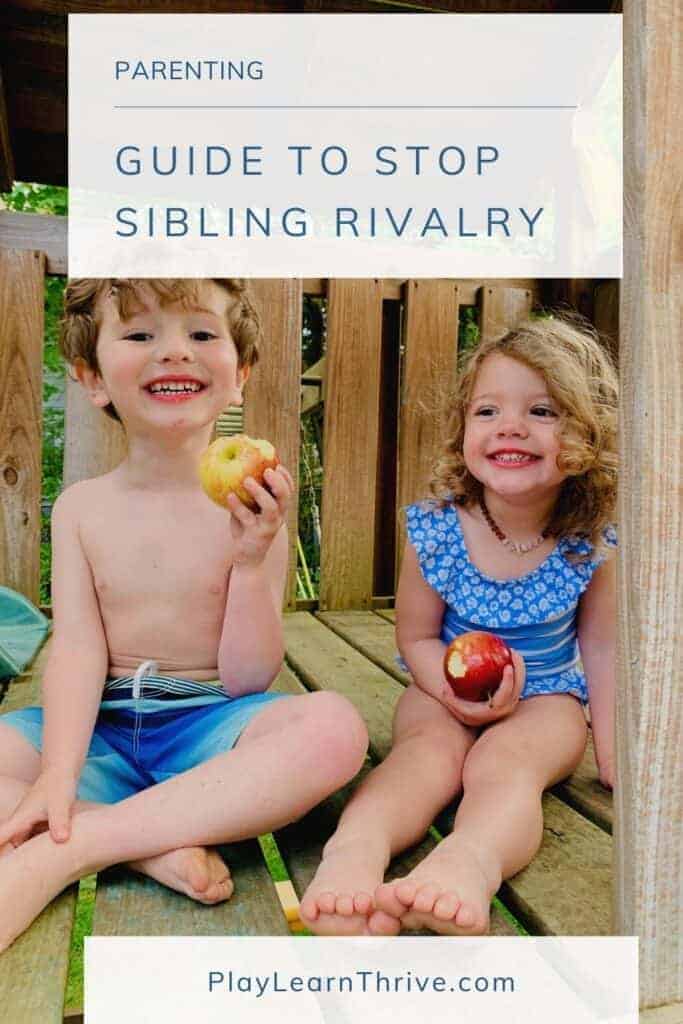
    Does this picture look familiar? One kid puts their foot too close to the other, and all of a sudden it’s on.

    Okay but they still fight…

    Yes, unfortunately some fighting is inevitable but here are some strategies to help get them to work things out on their own.

    1. Describe what you see. “Oh wow, looks like you’re really angry that Charlotte is using your truck and you want to hit her with that block.” (this is where you take the block)
    2. They will likely start telling you what happened. Listen to each side with respect and without judgement.
    3. Show you understand how difficult the problem is (and remember that even though a problem may seem small to us it can seem HUGE to them…) Say something like: “Yeah it’s really hard when someone is using something that is special to us.”
    4. Express confidence that they will be able to work it out on their own. If they are toddlers, prompt them with something like “Hummm you guys can figure this out together. Maybe Charlotte will play with the truck and you can play with [insert some other popular toy] and then you guys can switch?”
    5. Leave. Kids will work things out MUCH better on their own. If they aren’t hurting each other let them work it out. If it sounds like it’s getting too rough I will usually call out something like “It sounds like people are angry. Do you need me to come in there or can you figure it out yourselves?” More often than not they want to figure it out themselves.

    And what about when they physically hurt each other….

    1. If they are about to hurt each other, then it’s important to physically separate them. Remind them that they need to cool off first before they figure out a plan forward.
    2.  If you weren’t fast enough (which we all know is most of the time because these little suckers are fast AF) and they have already kicked, bit, hit, slapped, stepped on etc…. Make sure to focus on the one who was hurt vs the one who did the hurting. Give a quick but firm (not angry) “We don’t [insert violent action used]” and that’s it.

    Building a positive relationships from the start

    Obviously if kids have good feelings towards each other it will be MUCH easier for them to settle disagreements because they will want to get back to the positive relationship vs harping on the bad.

    A couple tips for building those positive sibling vibes

    1. Let them overhear you talk about how great they are as a team. “Wow, today Henry was teaching Charlotte to draw a face and Charlotte was helping Henry mix all the paints. They were really creating some great art together!”
    2. Direct them to ask for help from each other vs you.
    3. Instead of having them compete against each other as in “who can get upstairs to brush teeth the fastest” (which pits one against the other) it’s better to have them work together against you or the clock. So say something like “Do you guys think you can get upstairs and brush teeth before the timer goes off? Or before I count to 30?” Something that gets them working AS A TEAM not against one another.

    Read More

  • Road-tripping with toddlers

    Tips for Toddler Road Trips

    So this isn’t going to be your typical “Top 10 Tips for Road-tripping with a Toddler” post where I tell you the best toys to bring in the car and encourage you to load your kid with snacks to keep them happy in the car…but bear with me.

    We are going on a road trip tomorrow to a beach house. We will spend at minimum 4.5 hours in the car to get there. You know how many things I will do to entertain my kids in the car….. ZERO. I will do exactly zero things. Seriously. I can count on one hand the amount of toys I have given my kids to play with on car rides. They typically get a book or two and a small toy like a stuff animal, doll, match box car or small truck.

    We don’t do a DVD player, we don’t do an iPad, we don’t even do toddler music.

    Why? Because, I like to torture myself. No. Seriously, because I really feel like we, as parents (and as a society), are responsible for giving our kids plenty of opportunities to be bored. Being stuck in a carseat is boring AF. But my kids are so used to not being entertained in the car that they don’t even think twice. They sing, look for colors, ask us questions, point out trucks, sleep, they look out the window and daydream.

    Now listen, I’m not saying throwing on a DVD if you’re driving a ridiculously long way is a bad idea–I just think we need to intentionally seek out opportunities that allow our kids to be bored–and the car is a great place to start.

    It’s never too late to start letting your kids get bored…

    •  Limit the amount of toys they have access to in the car
    • Try to keep toys to basic open ended things that don’t require batteries
    • Books, books, books!
    • Don’t provide toys for shorter trips

    Read More

  • Understanding developmental leaps

    Developmental leaps. What are they? Why should I care about them?

    They are one of the biggest factors that will impact your infants behavior from birth to about 18 months–from their mood to their sleep. My 5.5 month old is currently going through a “leap”–she is super clingy, fussier than normal, constantly wanting to nurse but just sort of staring into space half the time–just generally acting a little off.

    What is a “developmental leap”?

    A developmental leap is a time during infancy when a baby is going through a big change in their understanding of the world and how things work. During this time your baby will begin to develop new skills.

    Why should I care about “leaps”?

    So you can stop stressing so much! Often times knowing that your baby is about to go through or in the process of going through a leap will calm your nerves. When you notice your little is a little off it could be a sign they are going through a leap–and it’s always reassuring to have some knowledge about WHY they are acting the way they are….

    What should I be looking for?

    • Crankiness
    • Clinginess (Wanting to be held more than normal)
    • Crying/Fussing
    • Restless sleep or change in sleep pattern (or changes in sleep–for example: my daughter has been putting herself to sleep by sucking her fingers but now all of a sudden wants to nurse to sleep)
    • Practicing a new skill

    What else do I need to know?

    Understand that these leaps are NORMAL and should be WELCOMED! This is your baby growing and changing. As hard as it is, it’s what they do….right?

    Also, understand that not everything is exact. It’s not like the leap starts on a specific day at a specific time–it’s a timeframe. Also note that there are often other things going on during these times too! Some of these leap phases are also accompanied by growth spurts (fun!) or sleep regressions (super fun!) or BOTH at the same time (the most fun ever!).

    If you want more information about these developmental leaps I suggest buying a copy of the book The Wonder Weeks. There is also an app you can download to help you track your baby’s leaps.

    Read More

  • Trusting your toddler

    Two weeks ago my two older kids started a new camp. It’s at their new Montessori pre-school and I am beyond pumped for them to begin school here. A few days into camp, my daughter (2.5), started saying she didn’t like her teachers. My first thought was legit terror. I have wicked anxiety and I usually always jump to the worst possible scenario in my head before I even have a chance to think anything through. That said, I took a breath and asked her why.

    She said “My teacher painted my rock.”

    I almost laughed. I pressed for a little more information because I couldn’t believe that this was what was making her so upset. She insisted that “my teacher helped me” and kept referring this rock. I almost brushed it off but then I thought about it and realized that she was legit upset because she wanted to work on this rock herself.

    I asked her if she was upset because she wanted to do it herself and she looked down, as if embarrassed, and said “yes.” I reassured her that it was OK for her to want to do things herself and that all she needed to say was “I don’t need help, but thank you!”–she laughed at my enthusiasm but I could tell she needed to hear that. She repeated it to herself with a smile on her face.

    I talked to her briefly about always speaking up if something didn’t feel right and reminded her it was OK to tell a teacher she wanted to try to do something herself.

    The next morning in the car ride we discussed her feelings about camp again. She wasn’t excited to go and said she didn’t “like camp.” I had a moment of clarity. I will say that I don’t always feel like a mom. I often tell new moms that I didn’t feel like a parent until my first kid was a toddler and I started dealing more with discipline. But it’s true–the day to day doesn’t feel like big “parenting” moments. Then you’re hit with something like this. Something small to you, but big to them. And these are the moments that make us parents. Our small decisions that ultimately help teach our kids something greater.

    It hit me that I needed to help her speak up for herself. It seems silly but she was very clearly upset and I hated the idea of her not being comfortable. I’m not one to intervene at every little thing, but I also think it’s so important to guide your children to grow in their own confidence and independence.

    I hoped her teacher wouldn’t think I was a nut case.

    We got to there and I led the conversation–I explained that Charlotte mentioned to me that she was upset because someone helped her paint her rock. Her teacher probably thought it was a joke at first but when Charlotte spoke up (after a little prodding) she took it seriously and reiterated to C that she just needed to tell her if she didn’t want help. Charlotte felt good. I felt good albeit a little ridiculous.

    When I went to pick her up that afternoon her teacher approached me again. She told me she had asked around to get the scoop about Charlotte’s rock. It turns out one of the teachers was holding the rock while Charlotte was painting. In that moment I felt silly for even making this a thing and I made a comment that made light of toddler concerns. At that her teacher reminded me that while it may seem silly to us, it was big to her. It was real to her. And I gave myself a little pat on the back.

    It’s always difficult to figure out what’s what when it comes to toddlers. They are master’s of all emotions, sometimes all at once. But I’m happy that I slowed down and trusted her. I listened and asked her genuine questions and even though she is only two and a half she understood–she understood her own feelings, she understood that she could say no thank you to an adult, and I hope that she, in some small way, understood that I will always have her back.

    She said “My teacher painted my rock.”

    I almost laughed. I pressed for a little more information because I couldn’t believe that this was what was making her so upset. She insisted that “my teacher helped me” and kept referring this rock. I almost brushed it off but then I thought about it and realized that she was legit upset because she wanted to work on this rock herself.

    I asked her if she was upset because she wanted to do it herself and she looked down, as if embarrassed, and said “yes.” I reassured her that it was OK for her to want to do things herself and that all she needed to say was “I don’t need help, but thank you!”–she laughed at my enthusiasm but I could tell she needed to hear that. She repeated it to herself with a smile on her face.

    I talked to her briefly about always speaking up if something didn’t feel right and reminded her it was OK to tell a teacher she wanted to try to do something herself.

    The next morning in the car ride we discussed her feelings about camp again. She wasn’t excited to go and said she didn’t “like camp.” I had a moment of clarity. I will say that I don’t always feel like a mom. I often tell new moms that I didn’t feel like a parent until my first kid was a toddler and I started dealing more with discipline. But it’s true–the day to day doesn’t feel like big “parenting” moments. Then you’re hit with something like this. Something small to you, but big to them. And these are the moments that make us parents. Our small decisions that ultimately help teach our kids something greater.

    It hit me that I needed to help her speak up for herself. It seems silly but she was very clearly upset and I hated the idea of her not being comfortable. I’m not one to intervene at every little thing, but I also think it’s so important to guide your children to grow in their own confidence and independence.

    I hoped her teacher wouldn’t think I was a nut case.

    We got to there and I led the conversation–I explained that Charlotte mentioned to me that she was upset because someone helped her paint her rock. Her teacher probably thought it was a joke at first but when Charlotte spoke up (after a little prodding) she took it seriously and reiterated to C that she just needed to tell her if she didn’t want help. Charlotte felt good. I felt good albeit a little ridiculous.

    When I went to pick her up that afternoon her teacher approached me again. She told me she had asked around to get the scoop about Charlotte’s rock. It turns out one of the teachers was holding the rock while Charlotte was painting. In that moment I felt silly for even making this a thing and I made a comment that made light of toddler concerns. At that her teacher reminded me that while it may seem silly to us, it was big to her. It was real to her. And I gave myself a little pat on the back.

    It’s always difficult to figure out what’s what when it comes to toddlers. They are master’s of all emotions, sometimes all at once. But I’m happy that I slowed down and trusted her. I listened and asked her genuine questions and even though she is only two and a half she understood–she understood her own feelings, she understood that she could say no thank you to an adult, and I hope that she, in some small way, understood that I will always have her back.

    Read More