Comments Off on Social Emotional Learning In Your Home
by alanna
Easy Ways to Incorporate Social Emotional Learning Into Your Home Routine
Now, perhaps more than ever, the letters S-E-L are on everyone’s lips. Parents, teachers, students, children, and families are experiencing stress and anxiety at this time. It’s often hard to know where to begin. Social emotional learning can help the whole family manage feelings, maintain relationships, and adjust positively to change.
We know that kids learn best through play. their development hinges on active involvement. So how can we bring social emotional learning into our home routine?
Gratitude helps social emotional learning
So much research has been done on the power of gratitude. People who practice gratitude experience the following:
better physical health
more optimism
increased resiliency
To begin, gratitude is a mindset, and it may or may not require a shift in your family dynamics. A great time to practice gratitude is before a family meal.
Coming together and talking about your day and what you’re thankful for is perfect social emotional learning practice.
Like everything our kids learn, modeling is powerful. Check your own words and actions. First, make certain you are saying ‘please’ and ‘thank you’ in your daily activities. Next, be specific when you thank someone. For example, say “Thanks for making dinner!”
Practicing gratitude as you go about your day is a great example for kids and will feel natural after a while. Notice your surroundings in the backyard with your kids. Are you grateful for your trees that give you shade? Your tomatoes that are growing so well? Make a point to say it out loud!
Kindness is Key
Have a kindness contest. Download a pre-made kindness printable or make your own and hang it on the fridge. Kindness activities might include things like ‘let someone else go first’ or ‘do an extra chore’. Set an individual and a family goal for how many acts of kindness you want to complete each day. Even better? Try to do an act of kindness without getting caught!
Turn Taking and Patience
Patience is a challenge for many of us, regardless of our age. Playing a game of Monopoly, Candyland, or UNO is a fun way to incorporate a host of skills, including taking turns. Board games also offer opportunities to practice winning and losing gracefully, as well as having conversations and maybe even using strategy. Taking turns is a great way to practice social emotional learning.
Mindful Breathing
Children can benefit in so many areas of their lives by practicing mindful breathing.
Among other things, mindful breathing can:
strengthen self-control
lower anxiety
improve emotional regulation skills
One way to practice mindful breathing is to ‘cool off the pizza’. To do this exercise, tell the child to pretend there is a hot slice of pizza in front of him. Have him take a deep breath in through his nose (to smell the pizza) and then slowly and steadily blow on the ‘pizza’ to cool it off.
The behaviors currently filed under ‘social emotional learning’ have been around forever, in the form of manners, good citizenship and self-awareness. Regardless of what these skills are called, life is much easier when they are worked into our home routine!
While it may seem counterintuitive to spend time creating an organized and thoughtful play space for kids who seem determined to destroy everything in their path, there is reason to do so.
Early educators often talk about the environment as “the third teacher.” This just means that our children’s environment has a big impact on their learning and development. The environment shapes how kids play.
You want to avoid these two mistakes when designing the play and learning environment:
Overloading with toys that leave little to the imagination
Organizing in a way that doesn’t encourage purposeful and independent play
A poorly planned environment can detract from your child’s learning.
How does the environment actually teach children?
Simple.
Urie Bronfenbrenner, psychologist and founder of the Head Start Program in the U.S., explains that the child impacts the environment.
Since the child influences the environment they are influenced by the environment.
A good learning environment will encourage children to engage in a variety of explorations. These explorations should be based on their individual preferences and needs.
Creating an amazing play space for your child doesn’t have to be expensive or overly time consuming. And you absolutely don’t need a dedicated playroom to create an environment that invites play.
Children need a space that is beautiful, simple, and organized. This is the type of environment that encourages discovery and exploration. It is this curiosity that teaches them the most.
We place enormous value on the role of the environment as a motivating and animating force in creating spaces for relations, options and emotional and cognitive situations that produce a sense of well-being and security”
3 Ways to Create an Environment that Supports Development
Incorporate a variety of sensory experiences.
Make sure you provide toys and other activities that give your child many sensory opportunities. You want them to be able to touch, smell, and hear in a variety of ways.
You can provide musical instruments, or something as simple as pots and pans to bang. Wooden blocks and blocks or building materials with different textures are a great addition.
You can create a sensory bin filled with rice, sand, or water. Sensory bins are a simple way to introduce a variety of textures to your little ones.
Create a space that supports the specific preferences of the children in that particular environment.
Think about what makes your child tick. What types of activities do they gravitate towards? Try to provide toys and experiences that help support those specific interests and consider how you can expand on those interests.
Make sure the environment is rich in content.
Thismeans having a variety of different types of reading materials available. Make trips to the library to bring home books about a wide range of topics.
Read out loud and listen to audiobooks. Encourage your children to ask questions and help them find answers.
It’s important to understand that a children’s environment should be a place that sparks collaboration, communication and creativity.
Want more information about the importance of play and tips to reorganize your playroom check out my e-book:Simply Play: Everything You Need To Know About The Most Important Part of Childhoodwhich you can buy here for only $4.99.
Do you like this post? If so, check out some of these related articles.
Comments Off on Must-Have Montessori-Inspired Toys
by Becky Korinek
You’ve done the research and read the articles about Maria Montessori, and know the benefits of open-ended toys. As you visit the toy store, though, it’s still very overwhelming – what should you buy? These must-have Montessori-inspired toys are just what your tired old toy collection needs!
The Best Montessori Toy for an Infant
Infants find the Skwish Rattle highly engaging on many levels. A perfect example of a Montessori toy, this teether/rattle combination is made of wood, elastic string, and bells. The rattle comes both in a natural wood finish and also a colorful, non-toxic, water-based finish. The Skwish Rattle’s design makes it easy to grasp, and the wooden dowels and bells are fun for babies to manipulate.
Another great toy is the even simpler-style Bell Rattle. This rattle’s simplicity and functionality make it a perfect Montessori toy. It fits perfectly into an infant’s tiny hands. Its light, compact design means that baby can make music all by himself!
Are you shopping for an older infant? The Rattling Roller is perfect for the baby who’s becoming mobile. This roller’s colors, motion and sound will intrigue your baby to crawl in order to chase it all over the floor.
Which Toys Do Toddlers Love?
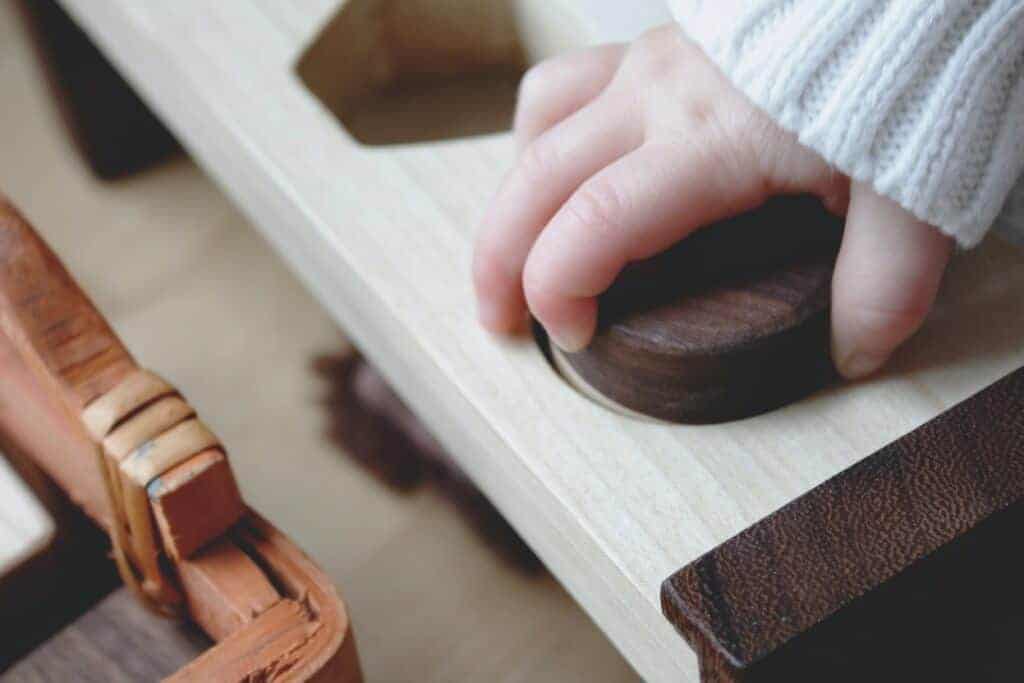
Toddlers have different play needs than infants. These toys will help them to learn more about the world every day. The Object Permanence Box is a sturdy, simple wooden box and ball that will keep a toddler busy!
A child begins learning about object permanence between four and seven months of age, and it remains quite a point of curiosity. This toy allows repeated, endless investigation of where exactly that ball goes.
When playing with this box, the child sharpens fine motor skills and eye-hand coordination while strengthening the understanding of object permanence.
Another way to strengthen eye-hand coordination in children is through Play Silks. These soft, smooth, beautiful pieces of fabric catch the air beautifully and invite children to try and catch them.
One hallmark of a Montessori toy is its versatility, and Play Silks are very versatile. Infants love the feel of these silks in their hands and their mouths, while toddlers enjoy taking them out of baskets and putting them back in. Preschoolers can use these silks as costume components and props for make-believe.
Blocks Are For Everyone!
Blocks are the universal toy that every playroom need. They’re sturdy, functional, and children of all ages can be successful with them. Here’s a twist on the standard wooden block: mirrors. Whaaa? Yep, you read it right: mirrors. Mirrored blocks go one step beyond standard blocks by further engaging the senses.
You Can’t Go Wrong
As long as you’re choosing durable, well-made toys that are open-ended, you really can’t go wrong. Keep in mind that a toy doesn’t need bells and whistles (electronic or otherwise) for it to be engaging and beneficial to a child.
First, child play therapy is an evidence-based practice for working with children in mental health. This type of therapy uses the natural language of children and the power of play to help children process their feelings and experiences.
However, child play therapy is not the same as regular, everyday play. Spontaneous play is a natural and essential part of the developmental process. While play therapy is a very specific approach to treating children.
How Play Therapy Helps:
Increasing their self-esteem and confidence.
Encouraging children to problem-solve their own challenges and build autonomy.
Providing a place to speak freely, be seen and understood.
Teaching communication skills to connect with others in a positive way.
Teaching them to understand their emotions.
Finding new skills to calm their bodies and brains.
Normalizing their experiences in the world.
Helping them feel like they are not alone.
The Natural Language of the Child
Often times children can’t articulate their stress or challenges until they are much older. This means we need to be realistic about how our children communicate.
The natural language of a child is play.
For example, play allows for expression and learning to happen in the lower more developed parts of the brain, also engaging the higher level cortex (cognitive part which is still developing).
Play is the way!
When a child plays, the toys they use are their words. The play is the story.
The story that is being worked out, processed, and incorporated into their developing brains and psyche.
Children can communicate and process their experiences through play.
Furthermore, play therapy is built on a relationship with a therapist who understands children, how their brains work, knows their developmental expectations, and how to best communicate with them (and their parents!) to ensure that everyone is on the same page and working together towards optimal growth.
Play does it all, so encouraging free play and engaging a child in play therapy hold many benefits for long term gain.
Making Sense of the World
Children are impacted by the world around them in more ways than we know.
And children are experiencing this global pandemic in ways that only history will tell us.
Adults frequently hide or shelter children from the news, but we know that whether or not children SEE the news, they know that something is wrong.
Also, they are able to SENSE the stress and impact the world has on their primary caregivers and that alone makes them feel anxious and afraid.
Children are observing the world around them and trying to make sense of it.
Again, play Therapy offers children a safe place to process those experiences, ask those questions, and make sense of the world around them. It is in play therapy that healing and prevention can occur.
It’s important to note that taking care of a child’s emotional and psychological world is just as important as caring for the health of their body and teeth.
Lastly, child play therapy is an amazing form of treatment for children of all ages and can be beneficial in helping children work through difficult emotions and experiences. If you believe that play therapy would be helpful for your child and want to find a Play Therapist in your area you can visit the Association for Play Therapy here.
To schedule an appointment with Olympia Therapy click here
This article was written in collaboration with Cary M Hamilton LMHC, RPT-S, NCC, CMHS, CDWF and Sarah Moran LMFT, RPT
Want more information about the importance of play and tips to reorganize your playroom check out my e-book:Simply Play: Everything You Need To Know About The Most Important Part of Childhoodwhich you can buy here for only $4.99.
Do you like this post? If so, check out some of these related articles.
Comments Off on There’s Nothing Educational About Educational Toys
by alanna
Which toy is better – a computer, or a box? A box – of course! Surprised? You shouldn’t be! A computer obviously has merit and value – think of the capabilities! But….a box does, too. Consider how often a toddler receives a gift, only to play with the box instead. It’s time to face the facts: there’s nothing educational about educational toys.
‘Educational Toys’: All About Marketing
The educational toy industry has always been profitable, and remains so. Friends and relatives alike often express love and affection through gifts. These well-meaning folks might prefer buying an ‘educational’ toy for the child versus something not labeled as such.
Their intentions are pure and perhaps they don’t know the first thing about toys – so they make their decision based on the word ‘educational’ on the box. Truth be told, the word ‘educational’ on a toy has about as much meaning as the word ‘healthy’ on a blueberry muffin. At best, ‘educational’ is subjective – at worst, misleading. Unfortunately, there’s nothing educational about educational toys.
What Are Educational Toys, Anyway?
If you’re a regular reader of this blog, you already know that it focuses on open-ended toys, purposeful play and child-led learning. ‘Educational’ toys do not figure into the equation. At the same time, though, every toy is educational – but what is it teaching?
Is it simply a matter of semantics? Perhaps. What does ‘educational’ really mean? The popular definition of an educational toy is one that ‘develops a special skill or is about a particular subject’. Manufacturers who market these toys will espouse their intrinsic value of helping children advance cognitively – but this claim is unproven. There’s nothing educational about educational toys.
What’s the Point of Play?
Is it the act of play itself that helps children to learn and grow, or is it a particular toy? It’s mostly about play itself, but obviously the object has some influence. The act of playing is so important to the overall development of a child that it has been recognized by the United Nations High Commission for Human Rights as a right for every child.
Maria Montessori said, “Play is the work of the child.” When children play, they learn and grow in every way imaginable, improving small and gross motor skills, developing language strategies, growing their imaginations and generally making connections with the world around them.
This ishow children learn – by actively engaging with everything in their environments. Play is essential to the cognitive, physical, social and emotional growth of the child. There is noONE TOY that will cause a child to grow cognitively. Instead, it is the synergistic aspect of everything that converges during playtime.
The Evolution of Toys
Children have always found ways to entertain themselves, even if ‘formal’ toys were not involved. Beginning with rocks and sticks, children interacted with their environment and learned while doing so.
Fast forward to 1693, when philosopher John Locke’sLocke’s Blocks came on the scene, with the intention of making learning to read more enjoyable. These blocks included letters, and were the precursors to primary-colored ABC blocks.
The next step in educational toys came between 1836 and 1850, when Friedrich Froebel, founder of Kindergarten, developed ‘Froebel’s Gifts‘. These specially-shaped geometric wooden figures supported learning about number, size, shape, weight, and cause and effect.
Another famous early childhood icon, Italian researcher MariaMontessori, is responsible for the next milestone in educational toys, which included multicolored rods, cylinders, towers and more. Montessori published the English version of her book The Montessori Method in 1912, which described the structure and function of these items.
Were Froebel’s and Montessori’s toys considered ‘educational’ in their day? If not ‘educational’, definitely ‘clinical’. While we know how much children learned by manipulating these items, the average home didn’t contain either Montessori’s nor Froebel’s playthings. Instead, most children at this time had yoyo’s, dolls and pogo sticks for toys.
How Did Educational Toys Come to Be?
Our level of concern about children definitely lives on a continuum. Let’s just say that there weren’t many ‘helicopter parents’ in the 1700’s.
As the Industrial Revolution dawned in the late 1700’s/early 1800’s, more people were working (read: more poor people were working). They needed somewhere safe to leave their children while they went to their factory jobs. For this purpose, ‘Infant schools’ were offered in churches, factories, and even private homes.
Wisconsin led the way in 1873, when they developed the first preschool. Other states followed Wisconsin, offering many versions of early childhood education, including nursery schools, day care centers and preschools.
About fifty years later, the NAEYC (National Association for the Education of Young Children) was established. Their mission is to promote high-quality early learning for all children, birth through age eight, by connecting practice, policy and research.
As child care facilities grew in popularity and advocacy organizations (NAEYC, etc.) became prevalent, there was more focus on child development. As a result, like a Judy Clock, the educational toy market began ramping up considerably.
Choosing Toys
When asked for toy recommendations, play experts today would not say ‘buy the educational ones’, but would advise ‘the simpler, the better’. Toys have gotten much more sophisticated since the late 1600’s, though, and finding simple playthings today is a bit of a challenge.
Some of the top toy companies currently include LEGO, Fisher Price, Mattel, Barbie, and Hasbro. Interestingly, LEGO, which began manufacturing its signature plastic bricks in the 1950’s, offers the most open-ended toys. LEGOs can be used to build virtually anything – the only limit is your imagination.
Do these top companies manufacture some open-ended toys? Sure they do – but one has to look a little harder.
Personally, I prefer to shop small.
Check out Monti Kids. A subscription that provides a personalized box of Montessori toys designed by Montessori teachers based on your child’s age and stage of development.
A box labeled ‘educational’ is nothing more than a marketing ploy. Don’t be fooled. A durable, open-ended, multi-purpose toy will keep up with the busiest child long after the box is gone!
Want to create a more purposeful play space? I invite you to join us with our purposeful play space course.Get ready to transform your play space, gain back your own time, and help your kids play independently!
Want more information about the importance of play and tips to reorganize your playroom check out my e-book:Simply Play: Everything You Need To Know About The Most Important Part of Childhoodwhich you can buy here for only $4.99.
Do you like this post? If so, check out some of these related articles.