play

  • Understanding the Importance of Play
    Understanding the Importance of Play

    We take for granted the importance of play for our children’s growth and development.

    Often times parents are so focused on early academics, scheduling play dates, setting up Pinterest worthy crafts, enrolling their kids in organized sports, and entertaining them with flashy “educational” toys.

    It makes sense that many parents get sucked into this as this is what our society has come to place above free and unstructured play. 

    We need to understand the importance of play for our kids.

    Play is HOW Kids Learn

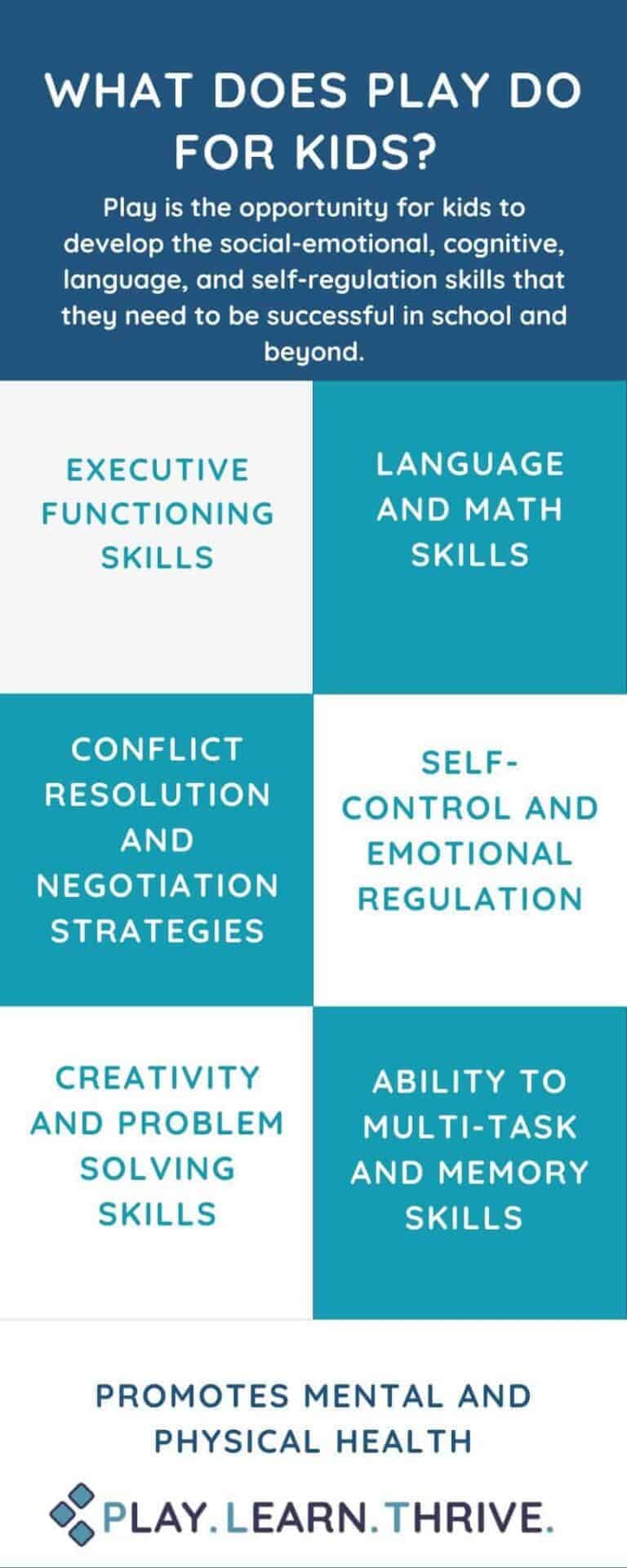
    It is how they develop the cognitive, social and emotional skills that allow them to succeed in all things. In a recent clinical report by the American Academy of Pediatrics (AAP) titled “The Power of Play: A Pediatric Role in Enhancing Development in Young Children” the abstract states play is “a singular opportunity to promote the social-emotional, cognitive, language, and self-regulation skills that build executive function and a prosocial brain.”

    So this concept is no joke.

    The importance of play cannot be overstated.

    The American Academy of Pediatrics is actually having to PRESCRIBE AND ADVOCATE for play. 

    This is what the AAP is recommending pediatricians do:

    1. Advocate for the protection of unstructured play because of it’s proven benefits in the development of motor skills that have lifelong benefits (such as preventing obesity, hypertension, and type 2 diabetes)
    2. Advocate for educators to focus on play by allowing children to take the lead and follow their own curiosity
    3. Encourage educators to put a “premium” on building social-emotional and executive functioning skills
    4. Advocate for protecting recess time in schools
    The Importance of Play Based Learning

    We have become so obsessed with “educating” our children; extending their school day, shortening their recess, increasing homework, signing them up for enrichment classes and organized sports, trying to provide them with endless stimulation and educational activities at home.

    Our society has forgotten that it is through play that children learn the process of learning.

    All the learning a child needs in their early years can be accomplished through play.

    What is play and why is it important?

    There are four basic types of play:

    Object play

    When children explore objects to learn about their different properties.

    Physical play

    Using and developing gross motor skills by doing activities such as running, jumping, wrestling, spinning and climbing.

    Outdoor play

    Play that happens outdoors and allows children to improve sensory integration skills

    Pretend play

    When children are experimenting with different social roles, including dress up, make believe and imaginary play.
    How much play do kids need?

    Okay so the importance of play. We know kids NEED to play. But how many hours a day should we be shooting for? An occupational therapist and author of one of my favorite books, Angela Hanscom, says kids should be playing (ideally outside) for three hours a day.

    That may seem impossible, especially given all the other commitments we tend to take on during the week but it’s time to make play a priority for our kids.
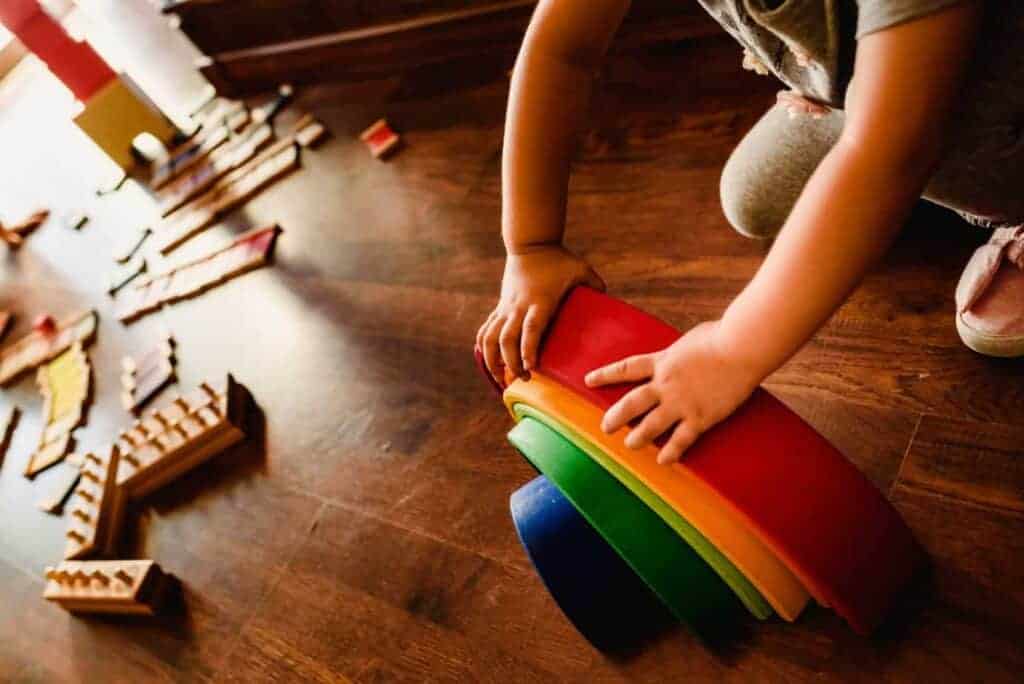
    7 Tips for getting in those “play” hours

    Break up the time

    It doesn’t all have to be done at once. You can “schedule” play as you would any other activity. This may be needed if you are used to a very booked schedule of classes, mommy and me activities etc.

    Unschedule your time

    Instead of going to a scheduled activity invite a friend or two over. Don’t stress about finding people with kids the exact same age, in fact, mixed age play is great for kids development.

    Don’t hover

    Sit back and let your kids do the work. Enjoy a book, a conversation with a friend, do your nails….seriously anything but getting to involved in your kids play. You may feel guilty at first but they need time to engage in play without adults participating or directing.

    Get Outside

    Visit a local park, playground, hiking trail. You don’t have to have a specific activity planned–I guarantee your little one will be able to find things to do given the opportunity.

    Evaluate your play space.

    Is it conducive to independent play? Are your toys open ended?

    If you need help with this, book a virtual consult! 

    Get the right gear

    Read this to make sure you have the right gear to play outside in all kinds of weather.  

    Don’t let messes get to you (hard, I know!).

    One of the best pieces of advice I was given specifically about kids and messes was….”there is no mess that can’t be cleaned up.”

    And a note about messes, I generally enlist my children to help clean whatever mess they make so it’s a win win. They get to play and get messy without me freaking out, and I feel like they are being taught a valuable lesson in picking up after themselves and contributing to our household. 

    If you’re looking for more information about the importance of play and tips to reorganize your playroom check out my e-book:Simply Play: Everything You Need To Know About The Most Important Part of Childhood which you can buy here for only $4.99.
    If you like this post and want to read more like it then check out these articles:
    Type of Play for Development
    100 Simple Things to do Outside With Your Kids
    Toy for Toddlers: Encouraging Active Play
    7 Essential Playroom Spaces (and why you need them)
    What I’ve Learned about Early Childhood Education
    Understanding Schema Play

    Read More

  • Outdoor Play: Why Does it Matter?

    Outdoor Play: Why Does it Matter?

    Research shows that the average American kid only spend 4-7 minutes in outdoor playing. Yet they spend 7 plus hours of time per day in front of a screen. This lack of time outside in unstructured play (no, organized sports don’t count…) is detrimental to our kids.

    To their health, their happiness, their creativity, their attention spans, their social, emotional and academic skills. 

    In an article titled “Getting back to the great outdoors” published by the American Psychological Association they quote research that connect times outside to brain development. The research states, “children who experienced the biggest increase in green space near their home after moving improved their cognitive functioning more than those who moved to areas with fewer natural resources nearby (Environment and Behavior (Vol. 32, No. 6).

    Studies have also found that the presence of nearby nature bolsters a child’s resilience against stress and adversity, particularly among those children who experience a high level of stress.

    Benefits of Outdoor Play

    • Physically healthier kids (better immunity, less obesity, more physical strength)
    • Mentally healthier kids (less anxiety, less depression, better moods and sleep)
    • Increase in attention span and creativity
    • Increase in sensory specific skills
    • Stronger ability to collaborate with others, adapt to new situations, problem solve, and negotiate–all life skills that your child will NEED to be successful in the world beyond school

    The need for risky play

    Children have an innate need for risk taking–and some research indicates that children who are encouraged to take risks at a younger age are able to better manage risk once they have gained more independence (so think about when your child is older and you want them to be able to manage risk when you aren’t there to swoop in to save them).

    It also shows that lack of ample opportunity to take risks may increase fear, inappropriate aggression, and the ability to cope with stress. 

    All of which translates into increased anxiety–this article also notes that “anxiety disorders are the most prevalent mental disorder in children and adolescents and parental overprotection has been associated with increased rates.”

    What does risky play look like?

    Some ways you may see kids engaging in risky play are:

    • playing at heights
    • running at high speeds
    • using things in ways that aren’t intended (climbing the couch, going up the slide instead of down), rolling down hills, climbing rocks
    • walking on anything that requires balance
    • spinning in circles
    • jumping off anything and everything

    These are things we should be encouraging our kids to do.

    To read more about risky play check out the article “A Guide to Understanding Risky Play”

    A little dirt never hurt

    Pick up a copy of the book Dirt is Good: The Advantage of Germs for Your Child’s Developing Immune System by Jack Gilbert Ph.D. for a more detailed explanation of why I let my kids eat dirt (and gasp…I don’t always wash their hands after they have played in dirt even when they are about to eat).

    Basically, exposure to low level germs and microbes are actually good for your kids as they help the immune system build itself up (read this article for more immune system boosting tips).

    Professor Gilbert explains that “exposure to microbes prevalent in the great outdoors will establish a stronger, more robust immune system in young people.”

    So stop stressing about washing off every speck of dirt, let your kids eat food from the floor, and stop using hand sanitizer unless you’re in a pinch and near “real” germs like cold and flu viruses (even then warm soapy water is best!)

    There is no such thing as bad weather, only bad clothes.

    This is not just a great book, but a philosophy lived by many families in Scandinavian countries and other areas of the world where outdoor play is held in higher regard.

    It’s much easier to get your kids outside when you have all the right gear.

    The right rain suit and boots can allow kids to stomp in puddles for hours.

    Rain Gear

    Some of my absolute must haves for outdoor play include the OAKI rain suit which my kids wear outside even in torrential downpour and still stay dry. Typically we wear base layers in the fall and spring as the OAKI suit is a thin waterproof material.

    We have tried both the Crocs rainboots and the Bogs rainboots.

    We prefer the bogs because they have a nice liner which makes them easy to slip on. They are also taller and made of a more flexible rubber.

    Base Layers (Layering)

    Baselayer just means the FIRST layer of clothing that is touching your skin.

    We mostly use merino wool as a base layer because the material is breathable, helps regulate body temperature and is a natural fiber.

    We love wool by Nui Organics and Sloomb because we wear a lot of wool year round, but if you just need a base layer you can get the Merino Kids thermal set by Simply Merino or these pajamas by Woolino.

    Many moms like to use fleece for warmth. Fleece is the synthetic version of wool. It isn’t as breathable as wool, but it is a great option and is typically less expensive. These are some good fleece options: The Rocky fleece thermals for girls and boys.

    Snow Gear

    For snow, we are LOVING our Patagonia Snow Pile one piece.

    We have tried a bunch of gloves and really love using these wool Melton Baby gloves underneath these POLARN O. PYRET waterproof shell gloves.

    What’s nice is you can use both of these separately or together depending on the weather.

    If your little one prefers a mitten style glove then you can get these waterproof shells and these merino mittens both by Polarn O. Pyret.

    For serious snow play we have been using, and loving, these Stonez Mitts. They cinch at the wrist and elbow and are super warm and SO easy to put on.

    As for hats I strongly recommend a baclava this like one from SmartWool, or a hat that pulls down over the ears.

    Our favorite snow boots are Bogs. I would recommend either the Bogs “Slushie” Snow boots or the Bogs baby waterproof boot. They are super easy to walk in and really protect their feet from the cold.

    My Outdoor Play Challenge

    I challenge you all to purposely send your kid outside to get dirty or play in weather you normally wouldn’t.

    Set up a water table and with a couple buckets of dirt and a shovel.

    Let them dig a hole and plant something with their bare hands. Then don’t freak out when you see them then stick their dirty fingers in their mouth or their nose.

    Bundle them up and send them outside in the snow. You can watch them from the shelter of your house if you need to.

    Put on those rain suits and boots to stomp in puddles and run around in the pouring rain.

    Just get those kids outside. Every. Single. Day.

    Ready to join an amazing challenge? Check out the 1000 Hours Outside Challenge!

    If you’re looking for more information about the importance of play and tips to reorganize your playroom check out my e-book: Simply Play: Everything You Need To Know About The Most Important Part of Childhood which you can buy here for only $4.99.
    If you like this post and want to read more like it then check out these articles:
    Type of Play for Development
    100 Simple Things to do Outside With Your Kids
    Toy for Toddlers: Encouraging Active Play
    7 Essential Playroom Spaces (and why you need them)
    The Power of Play
    What I’ve Learned about Early Childhood Education

    Read More

  • A Guide to Keeping Kids Busy

    How to Keep Kids Busy

    Do your kids constantly complain about being bored? Do they always need you to play with them?

    With everything kids have access to nowadays, how could they possibly be bored? How could a child with every hot new toy under the sun have trouble playing?

    Parents seem to be dealing with this more and more frequently. And report it starting earlier and earlier in childhood.

    Just a few days ago a mom was posting that her 18 month old was bored and she didn’t know what to do to keep him busy.

    Earlier today I came across another mom of a 6 month old asking for ideas to keep him entertained–expressing that she had “done” everything she could think to do for him.

    And that right there, friends, is the problem.

    So let’s talk about this whole idea of keeping kids busy. In theory this is well intentioned, but in practice it is deeply flawed.

    Children don’t need to be, nor should they be, hovered over or have every minute of the day perfectly choreographed.

    Giving the Gift of Boredom

    Unfortunately, hyper focus on our children has left our kids incapable of dealing with any lull in stimulation and hindered their ability to play independently.

    We forget that it is not our job as parents to “keep our kids busy” or “keep them entertained.” In fact, doing so directly impacts their ability to do these things for themselves.

    Our job is to provide a safe space with access to open-ended toys, art supplies and books and leave them alone. They will entertain themselves.

    The problem is that many children haven’t been given the gift of boredom.

    Boredom is what gives children the time to figure out what makes them happy, and allows them to develop skills like creativity, imagination, self-reflection, patience, and independence.

    Shifting Our Mindset: Do Less to Do More

    So for all the parents wondering how to keep their children busy during this time, I encourage a shift of mindset.

    Do less to do more.

    Children of all ages are capable of much more than we believe them to be.

    Don’t think about how to “keep them busy” instead find ways to encourage them to be independent by providing open ended toys that allow for more active play.

    Tips to Encourage Kids to Independent Play

    Minimize the amount of stuff you have out for your kids. If you are overwhelmed by the amount of toys out, imagine how they feel. 

    As a general rule, stay away from standard plastic and toys that light up, make noise, or talk. These types of toys can actually hinder play for children because they take away the need for imagination and creativity.

    Remember that the more a toy does, the less your kid has to do.

    Play is the work of the child so keep in mind the 90/10 rule when evaluating toys. That means a toy should do no more than 10 percent of the work.

    You want your child doing the thinking, visualizing, and creating.

    If you want some specific toy recommendations you can check out this post.

    Educational Toys Don’t Encourage Learning

    Many of the most common toys today actually take these opportunities away from kids. And while they are often labeled as educational, they don’t actually teach your child anything but how to be entertained by something else–leaving them wanting more and more.

    How many times has your child loved a bright shiny new toy, only to be over it after a few days or weeks. This is because the toy has done all it can for them, and they are looking for their next fix of stimulation.

    If they aren’t given enough time to rely on themselves for stimulation, you end up with kids who constantly need someone (you) or something (a new toy, activity, device) to keep them busy. It’s a pretty vicious cycle with pretty deep consequences.

    The Solution to “Keep Kids Busy”

    So the solution is pretty simple. Stop spending all your time trying to keep them busy and they will stop needing you to keep them busy. Trust in their ability to deal with their own discomfort (and don’t let their discomfort be yours).

    One of the best things you can do for your child is to let them figure things out for themselves.

    If you’re looking for more information about the importance of play and tips or reorganize your play space check out my e-book:Simply Play: Everything You Need To Know About The Most Important Part of Childhood which you can buy here for only $4.99.
    If you like this post and want to read more like it then check out these articles:7 Essential Playroom Spaces and Why You Need ThemHow to Continue Your Child’s Education During School Closures

    5 Tips for When School is Closed

    Understanding Schema Play

    The Power of Play

    The Ever Growing Importance of Outdoor Play.

    Toy for Toddlers: Encouraging Active Play

    100 Simple Things to do Outside with Your Kids

    Read More

  • The Importance of Mixed Age Play

    The Importance of Mixed-Age Play

    Children playing only with others of their own age is a relatively new concept. This idea of separating children by age has been made increasingly stark through our current (yet completely outdated) education system.

    Throughout most of human history, children played with other children in multi-age groups.

    Our society has swung so far to the extreme that it is rare to be able to find activities that are open for children of mixed ages. Also, it is rare to find children of various ages groups playing together unless they are family.

    Benefits of Mixed-Age Play

    This is an unfortunate trend. Mixed-age play (and mixed-age schooling) has been shown, through various studies, to have a variety of significant benefits to children of all ages. Some benefits are:

    • Better moral reasoning
    • More rapid cognitive development
    • Increased ability to understand literacy and numeracy concepts
    • Awareness of concepts that would traditionally be considered beyond their level
    • Increased social and emotional awareness

    Benefits of Mixed-Age Play for Young and Old

    Dr. Peter Gray notes, “Even when they are not playing together, younger children learn from older ones by watching and listening. They see older children climbing trees or solving puzzles, for example, and then they want to do that, so they work at it by emulating the older children’s actions.” In fact, from his research, he asserts that children are much more likely to learn from children who are a little older than them than from adults.

    The benefits are not just for the youngest of the group.

    Mixed-age play allows the older child to assume a greater sense of responsibility and practice nurturing in real time. They show a better sense of maturity and develop leadership qualities that can only be learned through actual experience with leading others.

    Being around younger kids allows them to play teacher and act as role models.

    It is often through these types of relationships that they develop a better sense of empathy, a stronger ability to compromise and collaborate, and a sense of empowerment to solve more complex problems or navigate unique social situations.

    Mixed-Age Play Impacts Kindness and Empathy

    Research across different cultures shows that older children who have more contact with younger children tend to be kinder. And they are not just kinder to younger children but kinder to others overall.

    When children play together in mixed age groups, they are constantly adjusting their behavior to meet the needs of the various ages in the group.

    When this happens children change how they speak, how they act, and what they expect from others.

    Little ones who would often have a hard time regulating their emotions might see the older kids dealing with similar disappointments and mimic how they are handling the situation.

    Older kids, who might normally exhibit behaviors inappropriate for younger kids, will step up because they understand the importance of being a role model.

    A Call to Action for Our Children

    Our current society often very strictly segregates children by age. This means it is important for parents and caregivers to move to provide more opportunities for children to spend time with others of different age groups. This is something that places like daycares, nursery schools, and enrichment classes need to address.

    If you’re looking for more information about how play to connected to learning check out my e-book:Simply Play: Everything You Need To Know About The Most Important Part of Childhood which you can buy here for only $4.99.

    If you like this post and want to read more like it then check out these articles:Type of Play for Development

    Guarding our Children’s Mental Health

    The Ever Growing Importance of Outdoor Play

    Toy for Toddlers: Encouraging Active Play

    7 Essential Playroom Spaces (and why you need them)

    The Power of Play

    What I’ve Learned about Early Childhood Education

    100 Things to do Outside with Your Kids

    30 Ideas to Get Your Kids to Play Outside

    Read More

  • 5 Steps to Encourage Independent Play

    5 Steps to Encourage Independent Play

    Design for Independent Play

    One of the biggest issues parents are experiencing right now is trying to keep kids entertained and busy while also working from home. But they aren’t sure what steps to take to encourage independent play.

    This shift in mindset will help. Try to think in terms of “how can I encourage independent play or learning.”

    NOT “how can I keep my kids busy or entertained.”

    This shift will allow your kids to develop important skills, while also keeping them engaged for longer stretches of time so you can actually get something done.

    Here are 5 Steps to Encourage Independent Play

    1. Minimize the amount of toys available

    Research shows that the kids with fewer toys have better quality play; often engaging in more creative and imaginative play. When kids are given less options (this study had kids getting four toys, and kids getting sixteen toys) they played for significantly longer periods of time. Having too many toys (or anything for that matter!) is a distraction.

    Think about how stressed you feel when you see so much “stuff” everywhere–you don’t know where to look, or what to do, it’s totally overwhelming.

    It’s the same for kids. You want to focus on providing fewer but more open ended toys that will encourage more active and imaginative play.

    If you’re looking for toy recommendations, check out my must have toys for toddlers.

    2. Open ended toys

    The types of toys you have available for your kids directly impacts the quality of their play. It’s best to have more open ended toys as this will promote more active and engaged play. Open ended toys are toys that can be played with in a variety of ways. They are simple and are typically the toys you have seen stand the test of time.

    That talking Elmo that lights up and dances? Popular for one holiday season (and really obnoxious).

    Building blocks. Pretty much popular since the dawn of man in some form or another.

    Toys have a significant influence on how children develop physical, social, emotional and cognitive skills. The key is to stay away from standard plastic toys, especially toys that talk, light up, move, or engage in any other way with your child. Anything with batteries should be cause for a pause.

    Keep in mind that the more a toy does, the less your kid has to do. The general rule of thumb is that a toy should do no more than 10 percent of the work. This leaves your child to do 90 percent of the work. If you want your child to play independently they need access to open ended toys.

    3. Organize in a way that makes sense to a child

    When organizing your space think about how you can provide easy access to the toys that will promote play.

    For example, we keep things like smaller legos, puzzles and board games higher up because my kids can’t do the entire process from start to finish by themselves.

    However, blocks, trucks, and pretend play items are easily accessible.

    Think about how tall your child is and try to keep items at or below that height. That way they do not need you to help them get a toy–which also means they don’t need you to put that toy away.

    Also, in terms of storage–open shelving and baskets work best vs closed bins (even labeled!), drawers or toys boxes. You want children to be able to see everything that’s available to them.

    4. Make it a “yes” space

    One of the best ways to make your life easier is to find a way to create a “yes” space for your kids. Make sure everything in this space is a “yes.” That means there is literally not a single thing that your kid could get into that would be an issue.

    Think about safety, but also about ability to access toys or other needs. Anticipate what they could ask you for, and find a way to make it available to them so they can do things for themselves.

    This gives you peace of mind knowing there isn’t anything they can get themselves into that is a huge deal and will allow them to play for longer periods of time without needing you.

    5. Away from adults

    Yes. AWAY from adults. Kids need space. They need to be left alone to play and immerse themselves in play.

    If your child isn’t used to playing in this way, or does not have access to open ended toys, this might be more difficult. It will take time for them to re-learn how to play independently and they may come to you with a thousand questions or want you to engage in play with them.

    Resist the urge to do this–set boundaries and find ways to “push” their questions back to them. I try not to even provide my kids with ideas for play–I just tell them “go play!” and they whine (sometimes because they want to be with me) and I repeat “go play!” You are not responsible for entertaining your child all day. Play is their job.

    If you’re looking for more information about the importance of play and tips or reorganize your play space check out my e-book:Simply Play: Everything You Need To Know About The Most Important Part of Childhood which you can buy here for only $4.99.
    If you like this post and want to read more like it then check out these articles:
    7 Essential Playroom Spaces and Why You Need ThemHow to Continue Your Child’s Education During School Closures5 Tips for When School is Closed100 Positive Things Parents Are Experiencing Right NowUnderstanding Schema Play

    The Power of Play

    The Ever Growing Importance of Outdoor Play.

    Toy for Toddlers: Encouraging Active Play

    100 Simple Things to do Outside with Your Kids

    Read More