play

  • Invitations to Play: A Misunderstood Concept

    Invitations to Play: A Misunderstood Concept

    An explanation of the phrase “invitation to play”

    Building off the concept of schemas is the idea of creating invitations to play. Simply put, an invitation to play is when an adult arranges toys in a way that is meant to spark a child’s interest.

    This is an amazing way to introduce new toys or get your child to expand their play by providing them with opportunities to make connections between toys they may not have seen for themselves.

    The common misunderstanding

    But there seems to be a fairly common misunderstanding about the purpose of invitations to play. This concept is directly derived from the Reggio Emilia philosophy of early childhood education.

    Reggio Emilia really focuses on following the child’s interest and using the environment as a third teacher. The materials provided in the child’s environment are meant to encourage exploration and spark interest without needing direction from adults.

    This concept has made its way from Reggio-inspired classrooms to the everyday parent who is looking to spark their child’s imagination. There are blogs, Instagrams, and Pinterest boards solely dedicated to giving moms ideas for invitations to play. And that’s great. However, I think it’s important to note a few things.

    I see moms constantly looking to get ideas for invitations to play. They seem stressed because they “can’t think of anything” or they are focused on providing their kids the perfect setup.

    I think that the concept behind creating invitations to play has gotten a little lost.

    How to Move Forward

    First, you don’t NEED to be doing this on a daily basis. In fact, you don’t need to be doing it at all for that matter. You child is perfectly capable of creating their own scenes for play if left alone with their imagination.

    That said, I understand wanting to.

    Maybe it brings you joy or you appreciate the way it allows your kids to play with things that might not always be top of mind for them. That’s amazing. You’re crushing it…

    I would encourage you to keep in mind that creating invitations to play is best done when you’re observing the schema (or schemas) that your child is really focused on in the moment and using that knowledge to create simple setups that build on their chosen focus. The idea is to follow the child.

    AND…Don’t stress if this is not your thing (it’s not really mine!).

    You can get TONS of ideas off Instagram and Pinterest, just PLEASE don’t beat yourself up over not being able to create picture-perfect invitations to play every day. I promise your little one will survive.

    If you’re looking for more information about the importance of play and tips to reorganize your playroom check out my e-book: Simply Play: Everything You Need To Know About The Most Important Part of Childhood which you can buy here for only $4.99.
    If you like this post and want to read more like it then check out these articles:Understanding Schema PlayThe Power of Play

    The Ever Growing Importance of Outdoor Play.

    Toy for Toddlers: Encouraging Active Play

    100 Simple Things to do Outside with Your Kids

    What is Montessori–Understanding this Early Childhood Education Philosophy

    Reggio Emilia — A Child Centered Learning Approach

    What is Waldorf — A Spotlight on Waldorf Education

    Read More

  • Understanding Schema Play

    Understanding Schema Play

    Schemas are patterns of repeated behavior that allow children to develop an understanding of the world around them through play and exploration. Schemas are mental models or processes that we create by trial and error through experiences.

    Kids are the perfect example of how we build schemas. They are constantly testing out concepts. You can easily notice these patterns of behavior in older infants and toddlers. Things like banging, pulling, pushing, and spinning are all examples of schema play.

    Following the Child

    The importance of early childhood education is well-established and reaches well beyond the preschool years. In fact, “early childhood” is considered birth to eight years old–so approximately 2nd or 3rd grade.

    This time period is crucial for children. I’d even go so far as to say more crucial than post-secondary education. Why? Because how and what they learn during this time period will provide them with a foundation for the rest of their lives.

    Education during these early years will help shape social, emotional, and physical health, as well as develop intrinsic motivation for lifelong learning–not just learning to get a grade.

    With that in mind, the basis of any early childhood education philosophy should be to follow the child. So, what does this look like?

    For more information about early childhood philosophies check out this article on Montessori.

    Child Development and Schemas

    It starts with newborns. From the time they are infants, we should be letting our children develop at their own pace, not forcing them into sitting or standing positions before they are ready, and observing what things make them feel safe and content–and providing those experiences.

    When they are toddlers, it means encouraging their natural curiosity and providing them with a variety of opportunities to connect with people, places, and things around them.

    As preschoolers, it means following their interests and not forcing them into learning concepts in order to “prepare them for school.”

    As young children, it means allowing them ample free time to pursue their passions–not signing them up for activities because it will “look good” or because it’s something you always wanted for yourself.

    In order to better understand your child’s development, it’s important to be aware of the concept of schema.

    Sign up here to get our FREE Quick Guide to Schema Play

    Common Schemas for Play

    Connecting and Disconnecting

    Children in this schema can be seen doing activities such as building train tracks, working with puzzles, joining things, lining toys up, or taking lids on and off. With this type of play, your child is trying to figure out how things fit together.

    Ways to support this schema: Train tracks, roadway building, construction materials, building materials that “fit together” like LEGO® or blocks. Even things such as tape, string, and velcro can be used to support kids within this schema.

    Orientation

    Playing in this schema involves things like swinging upside down, sitting in a chair the “wrong” way, and turning toys around to see things from different angles. This is children trying to figure out how the world looks through different points of view.

    Ways to support this schema: Mirrors, magnifying glasses, binoculars, climbing structures that allow them to climb or hang upside down.

    Transporting

    Kids who enjoy moving things from one place to another either use their hands or some sort of toy that can be filled, moved, and usually dumped. Children gain a sense of independence and responsibility when transporting items so you may find them eager to help you do chores that involve bringing something from point A to point B–like unloading groceries or moving clean laundry into the dryer.

    Ways to support this schema: Stroller or grocery cart, small boxes that can be easily picked up by little hands, a little backpack or pretend purse. Loose parts are also great in this schema because they are perfect for being loaded, moved, and unloaded over and over. A few pots filled with water or sensory bins that allow for kids to move things from one pot or bin to another are also good ideas for encouraging play within this schema.

    Trajectory

    This is a common schema that is focused on how things move. Children in this schema are studying how objects (or their body) move through the air. Remember your little one who constantly threw food off their highchair? They were learning about trajectory! Other activities that are a part of this schema are playing with running water, running, playing tag, throwing a ball, sliding down a slide (or watching how different objects slide down a slide).

    Ways to support this schema: Plenty of outdoor time and free space to run, throw things, pour water, send items down slides, or drop things from high places.

    Positioning

    Children working in this schema enjoy things like making patterns, lining up toys, ordering things in sequences. They will often spend a good amount of time trying to make things just right.

    Ways to support this schema: Loose parts that can be used to make patterns like the Grapat mandala pieces, small cars, or dolls.

    Enveloping

    This schema is all about wrapping things up. You may see them wrapping themselves in a blanket, wanting to put items in boxes, or swaddling their baby doll.

    Ways to support this schema: Give them plenty of blankets, pillows, silks, boxes, and anything else that allows them to cover and uncover themselves or their toys. Things like nesting bowls are also good for this schema.

    Enclosing

    This is similar to enveloping but more about creating a boundary. So for example, children working in this schema will create forts or make a fence for their farm animals. This schema is about containment.

    Ways to support this schema: Give children items to use to build forts (we love the Nugget®), large boxes, blocks that can be used to create a fence or boundary in some way.

    Rotation

    This schema involves anything that goes in a circular motion and can rotate. Things like wheels, washing machines, merry-go-rounds, and spinning around in circles are all a part of the rotation schema.

    Ways to support this schema: Provide your child with plenty of opportunities to play with streamers, spinning tops, and toys that have wheels. Household items like screwdrivers and nuts and bolts are also good for encouraging this schema.

    If you’re looking for more information about the importance of play and tips to reorganize your playroom check out my e-book: Simply Play: Everything You Need To Know About The Most Important Part of Childhood which you can buy here for only $4.99.

    If you like this post and want to read more like it then check out these articles:The Power of Play

    The Ever Growing Importance of Outdoor Play.

    Toy for Toddlers: Encouraging Active Play

    100 Simple Things to do Outside with Your Kids

    What is Montessori–Understanding this Early Childhood Education Philosophy

    Reggio Emilia — A Child Centered Learning Approach

    What is Waldorf — A Spotlight on Waldorf Education

    Read More

  • Kids Need Risky Play

    Risky Play

    Children have an innate need for risk-taking. In addition, children who are encouraged to take risks at a younger age are able to better manage risk once they have gained more independence. A lack of ample opportunity to take risks may increase fear and inappropriate aggression, as well as limit the ability to cope with stress. All of this translates into an increase in physical and mental health issues, particularly in children.

    What is Risky Play?

    To begin, risky play isn’t synonymous with dangerous play. For many adults, risky play is what we became accustomed to as young people. This was before fear became an all too present element in parenting.

    Remember riding your bike alone or exploring the creek in the neighborhood park? These are normal, everyday activities that children should experience. Today, however, children are experiencing risky play less and less often.

    Some ways you may see kids engaging in risky play are:

    • playing at heights
    • running at high speeds
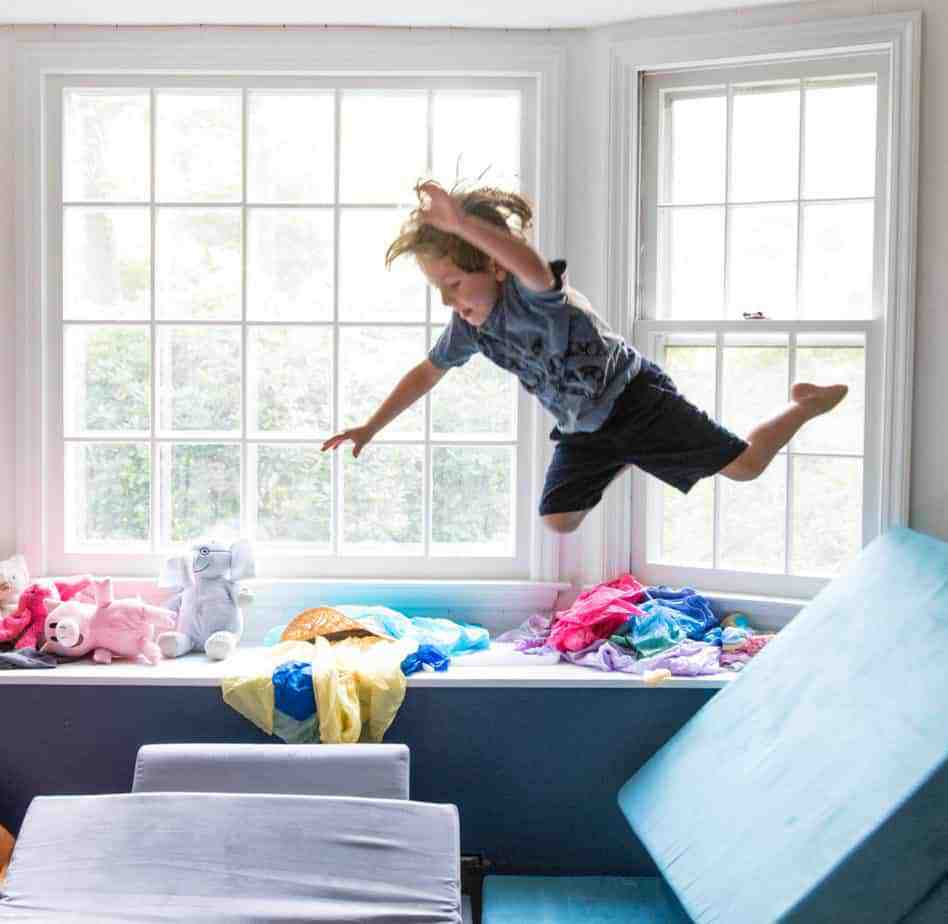
    • using things in ways that aren’t intended (climbing the couch, going up the slide instead of down)
    • rolling down hills
    • climbing rocks
    • walking on anything that requires balance
    • spinning in circles
    • jumping off anything and everything

    In addition, risky play is often unstructured. This means that the child is free from direct adult supervision. Of course, if you have a young child engaging in risky play, you may still be at the park or in the home nearby, but you are letting them climb, explore, and build without fear or retribution. Risky, unstructured play gives the child a chance to explore, imagine, and self-regulate in a way that structured, adult-initiated play does not.

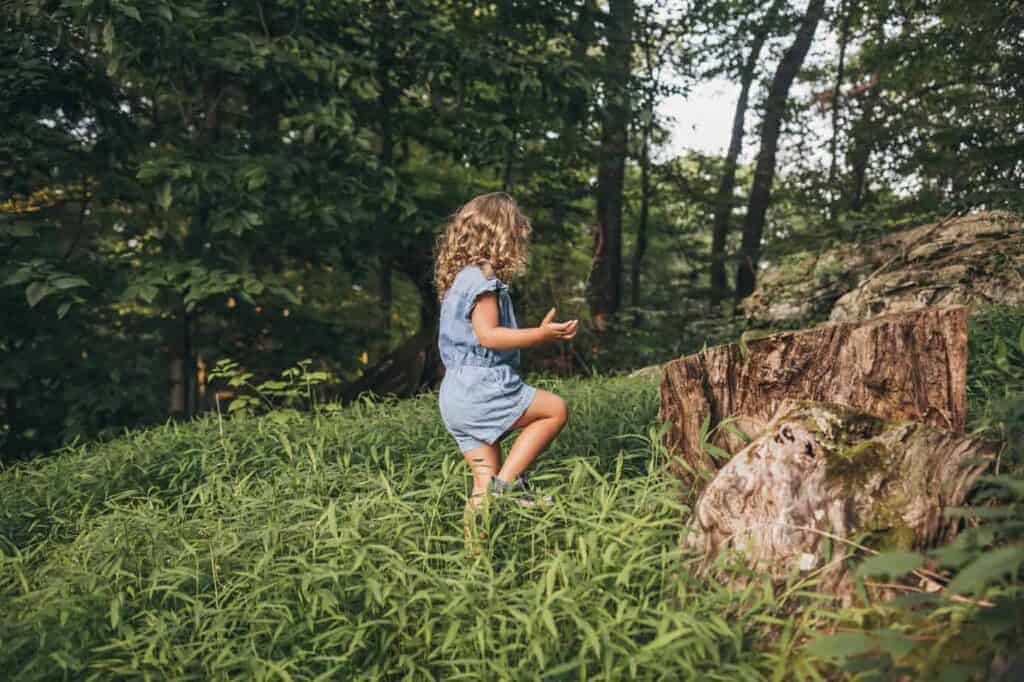
    Although risky play can happen indoors, so much of positive risky play happens outdoors. In a world dominated by screen time and personal devices, I am a huge advocate of getting our kids outside to experience nature! Rain, snow, or sunshine, outdoor play with risky elements helps children engage in imaginative exploration.

    Research on Risky Play

    Dr. Peter Gray writes in his book Free to Learn, “Over the past 60 years we have witnessed, in our culture, a continuous, gradual, but ultimately dramatic decline in children’s opportunities to play freely, without adult control, and especially in their opportunities to play in risky ways. Over the same 60 years we have also witnessed a continuous, gradual, but ultimately dramatic increase in all sorts of childhood mental disorders, especially emotional disorders.”

    Gray’s findings come from the study of a school, Sudbury Valley, that focuses on the philosophy of student ownership and community responsibility of learning. Ultimately, the students design their own learning path. Grade levels and formal courses are not part of the Sudbury way. In fact, risky play and exploration is encouraged. Gray sees the result as students that are more resilient, independent, and able to navigate the world after their school years.

    Parental (Over)-Involvement

    Today, parents are often seen hovering over kids at the playground, or even worse, following them up into the playground equipment. Parents aren’t necessarily doing this to play with their child but to make sure they don’t fall or get minor bumps and bruises. “Helicopter parenting” isn’t necessarily new, but it seems like it’s becoming the norm rather than the exception. This also means many children aren’t scaling rocks and climbing trees anymore. They aren’t jumping from heights that are just a little too high. Our kids aren’t taking risks!

    Funny enough, injuries haven’t decreased. In fact, it’s been quite the opposite. Why? Children are not testing their bodies enough. They are more likely to get hurt because they are grossly unaware of their physical limits.

    We need to shift our mindset. These are things we should be encouraging our kids to do. Take a breath, step away from the top of the slide, and let them take healthy and age-appropriate risks. As Gray states in his 2014 Psychology Today article, “Play, to be safe, must be free play, not coerced, managed, or pushed by adults.”

    Benefits of Risky Play

    When children are allowed to engage in risky play, it gives them a chance to expand their imagination. For example, building a fort out of couch cushions and furniture that a child may climb over and under can open a world of story-telling, building, and all-over imaginative play!

    The power of play itself simply can’t be disputed. Play is the basis for how young children learn. By encouraging risky, unstructured play, children develop physical and mental skills that build imagination, resilience, and physical endurance.

    Gray also states that risky play allows children to experience a healthy sense of fear. When adults do not allow kids to engage in risky play, they are unable to experience self-regulation and understand what their limits are.

    Besides just being plain fun, risky play gives young people a chance to build resilience, fear, strength (in spirit and physicality), and experience a world of imagination. It’s time for adults to remember what it was like to be young again when risky play was a normal part of our everyday lives! Let your kids play, set some appropriate boundaries, of course, but let go a little bit to let them experience risky play.

    If you’re looking for more information about the importance of play and tips to reorganize your playroom check out my e-book:

    Simply Play: Everything You Need To Know About The Most Important Part of Childhood which you can buy here for only $4.99.

    Read More

  • Play Based Learning During School Closures

    You’ve got everything organized and ready for Monday. Pencils, paper, glue, erasers, maybe a protractor for good measure — all the implements of a proper education. You’ve put a great deal of thought into how best to organize your “classroom” and you have some lesson plans up your sleeve now that school is out for the foreseeable future.

    I applaud your efforts to fill the gap in your child’s education now that the coronavirus has upended your family’s normal routine.

    And I’m going to stop you right there.

    Because all your plans, though well-intentioned, are completely unnecessary.

    There’s no need to panic. Child development experts want you to know: You can make the transition to homeschooling quite adeptly by allowing your kids to lead. The best part? The responsibility for “educating” your child doesn’t fall solely on you.

    In fact, with a little preparation, following your child’s lead and sharing control of educational choices puts learning where it belongs — quite literally, in your child’s hands.

    Play is a child’s best education

    If you’re like a lot of parents right now, you may find yourself jumping both feet first into something you haven’t thought about much since, well — since you yourself were in school. And like a lot of parents who find themselves suddenly responsible for their child’s “formal education,” you may tend to fall back on what you know — that is, “school” as you remember (or imagine) it: children at desks and the teacher standing at the front of the class, drilling them with info on a chalkboard and some kind of pointer and glasses that tightly pinch her scrunched-up nose.

    This is what’s been called the “grammar of schooling,” and like the grammar of language, these are the “rules” that define our understanding of “school” even if we never give them much thought. Classroom teachers, to be sure, give a lot of their time to the arrangement of desks and lesson plans and standardized tests.

    Fortunately for you, your classroom isn’t restricted by four walls and your lesson plans are free and all around you as long as you keep in mind one very simple rule: Children learn best through play.

    Play: how memories are made

    Think about it. Your child hears the trills of the spring’s first toads and asks, “Mommy, what’s that?” Maybe you don’t know! You could scour the internet or a library for an answer, or you could take an option not always available to teachers with 30 kids in a classroom: You can learn by direct investigation, or, in other words, through play — by allowing kids the freedom to make choices and manipulate materials and find out for themselves the answers to important questions.

    It’s called play-based learning, and seasoned educators and parents alike know that it’s how a child learns best. With that in mind, the National Association for the Education of Young Children (NAEYC) recommends these “five essentials to meaningful play” for those backyard investigations and field trips to the pond and other memory-making activities.

    Children make their own decisions.

    Allowing kids freedom to make their own choices (and mistakes!) is the heart of play-based learning. Parents and teachers can help by providing lots of open-ended materials for children to explore and get creative with. If you suddenly find yourself with a house full of kids on short notice, you can take comfort in the fact that the best and most widely available open-ended materials are also free and right outside your door. While a plastic toy rocket ship is often just a plastic toy rocket ship, the natural world provides infinite materials, from sticks to stones to pine cones, for children to discover and explore and use to make creative choices.

    Children are intrinsically motivated.

    Famed developmental psychologist Jean Piaget referred to play as the “work” that children do to make sense of their world. Kids have an internal guide — a natural impulse — to play as a form of discovery. Not sure how to satisfy restless children on short notice? Ask them what they’re curious about!

    Children become immersed in the moment.

    We remember the “good old days” of biking around our neighborhood and late evening baseball games in the backyard not because we’re simply victims of nostalgia but because we’re recalling the most formative memories from our childhood — memories solidified precisely because they were formed when, as children, we were immersed in our play and lost awareness of our surroundings and became focused completely on what we were doing. It is in that immersion that memories are formed — the kinds of memories that last a lifetime.

    Play is spontaneous, not scripted.

    Children are flexible in their play. Sometimes they’ll make a plan and stick to it; other times, their play will evolve as new information emerges. The “unknown” nature of play allows children to develop valuable life skills, both flexibility and persistence. Parents and teachers should certainly play cooperatively with children, but should resist the urge to make decisions for the child’s play. As children encounter challenges within their grasp, gentle guidance from a trusted adult (or “scaffolding”) can lead them to the next stage of their development.

    Play is enjoyable.

    What’s the difference between a visit to a swamp and completing a worksheet on frog habitats? The former is fun, the latter, less so. And that difference is all that matters to a child who is exploring her own world, because it’s this difference that determines whether a memory is relegated to the nether reaches of her brain and forgotten, or experienced as a novel — and therefore memorable — event.

    Whether you’re homeschooling by necessity or choice, or just interested in how you can keep children learning on weekends and summer breaks, now is the time for active, play-based learning, and that can come in many forms. Thank heaven you’re not restricted by state standards and testing requirements. When a child is making choices and doing something challenging, with the proper adult guidance and scaffolding, they’re learning. So make granola in the kitchen, learn to play dominoes, build a bridge, start that long-term project you don’t ever seem to have enough time for, and get outside for some all day recess!

    You don’t have to wait until Monday!

    Resources

    Nell, Marcia L., & Drew, Walter F. Five Essentials to Meaningful Play. https://www.naeyc.org/our-work/families/five-essentials-meaningful-play

    Tyack, D., & Cuban, L. (1995). Tinkering toward utopia: A century of public school reform. Cambridge, MA: Harvard University Press.

    If you like this post and want to read more like it then check out these articles:

    Covid-19: Tips for When School Is Closed

    30 Ideas to Get Your Kids Playing Outside

    100 Outdoor Activities to Do with Your Kids

    Top 10 Must Have Art Supplies

    Type of Play for Development

    Toy for Toddlers: Encouraging Active Play

    Read More

  • Free to Learn by Peter Gray: A Book Review

    Free to Learn by Peter Gray: A Book Review

    As a public school educator and a parent, I am constantly reading topics about education, inquiry, and play. I love public schools, but there is no secret that time for play has been replaced with standardized test preparation in schools. At home, structured activities in the form of sports, dance, music, and more often take priority over free play. These activities are also important, but freedom to learn through unstructured play is something I am passionate about, both in school and at home.

    In my doctoral studies, I came upon the book, Free to Learn: Why Unleashing the Instinct to Play Will Make Our Children Happier, More Self-Reliant, and Better Students for Life by Peter Gray, a research professor and scholar from Boston College. Although some of Gray’s ideas when it comes to education may seem extreme, there is a lot parents and teachers can learn from this book.

    Gray writes that the decline in free play and emphasis on structured education and activities directly contributes to the rise in stress-related mental disorders and depression in young people. It comes down to this. When our children are able to make their own decisions regarding the when, where, why, and how of learning, they are more likely to learn and be motivated to learn.

    Gray’s research draws on an anthropological study of hunter-gatherer children, a historical study of the impact of agricultural mores, feudalism, and monotheistic religion in the eventual rise of formalized, compulsory education. The historical context is an important review of the history of compulsory education, although not a comprehensive study. Gray’s focus goes beyond education itself and looks at learning.

    Students Responsible for Their Own Learning

    Sudbury Valley first operates on the principle that “adults do not control children’s education; children educate themselves”. In effect, learning is a uniquely personal experience. The student is part of the community. Students are not only responsible for decisions regarding their own learning but the decisions regarding the existence and responsibility of the school community as a whole.

    The Seven Sins of Compulsory Education

    In Free to Learn, Gray addresses the seven sins of our system of forced education. Whether you are homeschooling or your children are attending traditional school, these are important concepts to look at. Through extensive case studies of a private, radical constructivist school, Gray uses research to support the claim that formalized education guilty of the seven sins causes many students not to enjoy school. Gray addresses the need for students to be at the forefront of decisions when it comes to not only what they learn, but where, when, how, and even whom they learn from.

    In the book, Gray focuses on the sins in our current system of compulsory education.

    • Denial of liberty without just cause and due process
    • Interference with the development of personal responsibility and self-direction
    • Undermining of intrinsic motivation to learn (turning learning into work)
    • Judging students in ways that foster shame, hubris, cynicism, and cheating
    • Interference with the development and cooperation and promotion of bullying
    • Inhibition of critical thinking
    • Reduction in diversity of skills and knowledge

    In addressing these “sins”, Gray studies Sudbury Valley School, a privately funded school founded in 1968 on the principles of self-directed, student-held responsibility of learning. Students and staff have a vested democratic say in the community through a “School Meeting” model.

    The Denial of Liberty Without Just Cause and Due Process

    Each of Gray’s “seven sins” have student ownership of learning as the focus. First is the denial of liberty without just cause and due process. The way to reinstate liberty is by allowing play. Gray said, “Play is always accompanied by the feeling of this is what I want to do right now”. Yes, play has rules, but the rules should be agreed upon by the group. This also allows for a democratic community.

    Interference with the Development of Personal Responsibility and Self-Direction

    Next, Gray focuses on the second “sin of our system of forced education”. This is interference with the development of personal responsibility and self-direction. Gray explains that the forced nature of schooling stifles curiosity that children are born with. Compulsory schooling turns learning into work, something to be avoided. When teachers take control of children’s learning and tell that work must come before play, then learning no longer becomes an act of joy but becomes work. Comparing student learning and work with other children not only becomes work but a source of anxiety which inhibits learning.

    Undermining of intrinsic motivation to learn (turning learning into work)

    The third sin of compulsory education, undermining of intrinsic motivation, starts when students enter formal schooling. No matter how engaging and fun teachers attempt to make class activities, learning tasks are traditionally referred to as “work”. Gray mentions that teachers often say, “you must do your work before you can play”. Using anthropological studies of hunter-gatherers and evidence of modern pre-school-aged children, Gray is able to assert that children are naturally playful and curious, and school, is ultimately what kills their desire to learn.

    Judging students in ways that foster shame, hubris, cynicism, and cheating

    The fourth sin is focused on the sins of grading by judging students in ways that foster shame. One of the most shameful parts of education, according to Gray, is the way we teach children that their worth is determined based on others’ judgments through class rank or grades. Overall, when the value is placed on grading rather than learning, cheating becomes a preferable option for students faced with inferior grades or those competing in the cutthroat system of education.

    Interference with the development of cooperation and promotion of bullying

    Through segregation by age, caging students, and the atmosphere of competition, schools become places that interfere with the development of cooperation and promotion of bullying, the fifth sin. Children that develop at a slower rate physically, academically, or emotionally are placed with peers that may not relate with In addition, when students are allowed to age-mix, which is often seen in free play (think neighborhood children playing outside), the presence of younger children helps older youth develop their nurturing skills. The decline in age-mixed play has aligned with the rise of narcissism among youth. This lack of self-concern, according to Gray’s research, comes from the age-grading.

    Inhibition of Critical Thinking

    Curriculum, standards, and grading relate to the sixth sin of forced education, inhibition of critical thinking. Too often, grading rewards “correct” answers, and what is deemed correct in schools is the information and questions given to students from the teacher rather than students generating the questions.

    The Sudbury Valley School, which serves as Gray’s model for schooling, does not assign grades. Students still report success beyond high school. Seventy-five percent pursued higher education and 82 percent of students reported that their education benefited them by helping them think more critically and take responsibility for their own learning. Gray, using qualitative research methods, studied graduates via surveys, which became additional research studies after Gray’s initial findings.

    Reduction in diversity of skills and knowledge

    Finally, the last sin is reduction in diversity of skills and knowledge through a system that focuses on all children rather than individuals. Standardized curriculum reduces opportunities for students to follow different pathways. In Sudbury Valley, students decide and propose what they will study and learn. Because the diversity of personalities and in knowledge is valued, students at the Sudbury Valley School are ultimately very successful in pursuits beyond secondary education.

    What does this mean for parents and teachers?

    What can parents and teachers learn from Gray’s book? As a teacher, I still have faith in public education. I am not ready to uproot the entire system and disregard all standards and systems of aged socialization. However, there are a few things you can do as a classroom teacher or a parent to negate the seven sins.

    Foster Inquiry

    Kids are intrinsically curious, but too often schools tell them what questions to ask. By implementing Genius Hour or Passion Projects at school or home, your children will be able to explore and learn things that are authentic and meaningful to their own learning goals.

    Give Choice

    Instill elements of democratic learning by giving your children choice in the way they demonstrate their learning through the mode or output when it’s applicable. I’m such a huge fan of Genius Hour in helping students reach their future goals. One of my students once told me that they didn’t enjoy school because they weren’t learning things that were going to help them in the future. That may only be partially true, but letting students explore their passions with specific learning targets and goals is so meaningful.

    Allow Free Play

    There’s nothing that frustrates me more than when I see recess being taken away from young children. Even older children need time to experience “free play, but when our youngest learners are exchanging recess for testing, we’re doing them no favors. Taking a little time away from structured school helps mental health for kids and teachers. Not only does free play help with social-emotional learning, it also increases imagination.

    Embrace Boredom

    It’s more than OK for kids to be bored. Over-scheduling and even unintentional scholastic competition can lead to shame and cheating. Let your children learn for the sake of fun and curiosity and play without it being planned.

    The 21st century child is changing the world. Gray embraces play and student-direct learning, but even if your school or homeschool isn’t curriculum-free or 100% student-led, looking at Gray’s “seven sins” can certainly help you think about what today’s education could be for your child when we bring back curiosity and play.

    Jen Schneider is a middle school public school teacher and PhD student in Omaha, Nebraska. She writes about education at Creative Tech Teacher

    If you’re looking for more information about the importance of play check out my e-book:

    Simply Play: Everything You Need To Know About The Most Important Part of Childhood which you can buy here for only $4.99.

    If you like this post and want to read more like it then check out these articles:

    Type of Play for Development

    Guarding our Children’s Mental Health

    The Ever Growing Importance of Outdoor Play

    Toy for Toddlers: Encouraging Active Play

    7 Essential Playroom Spaces (and why you need them)

    The Power of Play

    What I’ve Learned about Early Childhood Education

    100 Things to do Outside with Your Kids

    30 Ideas to Get Your Kids to Play Outside

    Read More